
Introduction
Operating a crane on land is a predictable science calculated by static variables: ground bearing capacity, radius, and counterweight mass. At sea, every calculation becomes dynamic. Heavy-duty lifting gear installed on ships, barges, and offshore platforms faces a continuous assault from high humidity, salt spray, constant motion, and changing sea states.
Understanding how marine cranes work on deck is essential for shipyard engineers, marine contractors, and equipment dealers. Whether loading cargo, deploying commercial workboats, or transferring supplies between vessels, selecting the wrong configuration can cause premature component failure, dangerous shifts in vessel stability, or catastrophic accidents. This guide breaks down the mechanics, engineering, and selection strategies required to deploy a safe, high-ROI marine lifting solution.
1. Anatomy of Marine Cranes: How They Differ from Onshore Equivalents
At first glance, a deck-mounted crane looks identical to land-based heavy machinery. However, the internal engineering is completely reimagined to withstand corrosive environments and dynamic loads.
• Anti-Corrosion Structural Integrity: Standard land cranes rely on basic industrial primer and paint. Marine-grade lifting systems require multi-layer C5-M certified epoxy coating systems to withstand continuous saltwater exposure. Critical wear components—such as hydraulic cylinder rods—are typically manufactured from high-grade stainless steel or treated with nickel-chromium plating to prevent pitting and rust.
• Sealed Slewing Systems: The slewing ring (the gear that allows the crane to rotate 360 degrees) is fully enclosed with specialized marine seals to prevent salt crust build-up. Unlike a land crane working on flat terrain, a deck crane must rotate while the vessel is listing or pitching. This demands heavy-duty, high-torque hydraulic swing motors capable of fighting gravity when rotating uphill against a listing hull.
2. Choosing the Right Boom Configuration for Deck Operations
Selecting the right boom configuration directly impacts your vessel’s usable deck workspace and its specific handling capabilities.
Knuckle Boom Cranes (Articulated Cranes)
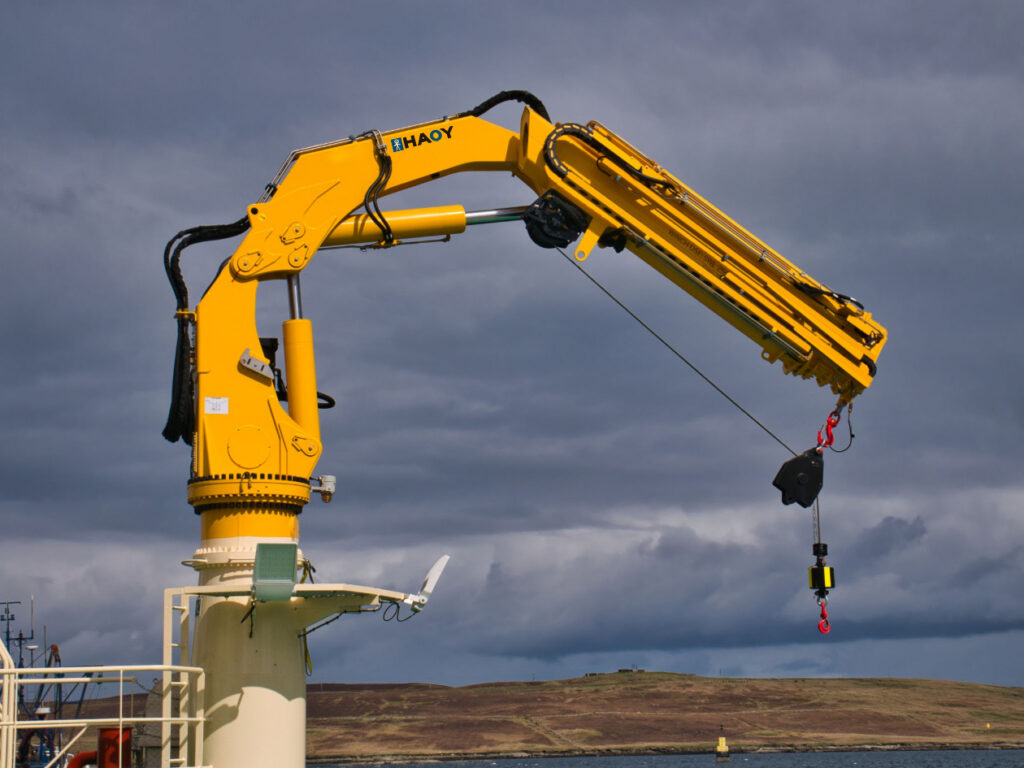
For vessels where deck real estate is at a premium—such as offshore supply vessels (OSVs), fishing trawlers, and compact workboats—knuckle boom cranes are the gold standard. These systems feature two distinct booms connected by a hydraulic knuckle joint. This design operates much like a human finger, folding down tightly when not in use to leave maximum deck area for cargo. The articulation allows the operator to lift loads vertically over high bulwarks and place them precisely onto the deck without the swinging pendulum effect associated with long winch lines.
Telescopic Boom Cranes (Straight Boom Cranes)
When an operation requires direct, extended reach rather than close-quarters flexibility, telescopic boom cranes offer a simpler, highly rigid solution. Utilizing a series of rectangular or hexagonal boom sections that extend linearly via internal hydraulic cylinders, these systems excel at deeper winching operations, such as launching subsea equipment or servicing wind turbine foundations. While they lack the tight folding capability of articulated designs, straight-line telescopic booms offer highly predictable load distribution and simpler maintenance schedules for long-term deployments.
3. The Powerhouse Behind the Lift: Marine Hydraulic Systems
The lifting, luffing, and rotating actions of deck machinery depend entirely on advanced hydraulic circuitry. Marine hydraulic systems are closed-loop or high-pressure open-loop networks designed to prevent cavitation (gas bubbles forming and collapsing in the oil) caused by the constant motion of the vessel.
Commercial-grade marine lifting equipment uses specialized proportional valves. These valves give operators fine-grained control, allowing them to make micrometric adjustments to the crane’s position even when the vessel is rolling on ocean swells. Powering these systems requires a reliable hydraulic power unit (HPU). Depending on the vessel’s architecture, the crane can be integrated directly into the ship’s central hydraulic line via a Power Take-Off (PTO) clutch, or it can operate via a self-contained, deck-mounted diesel or electric-hydraulic HPU package.
4. Managing Dynamic Forces: Vessel Options and Stability Control
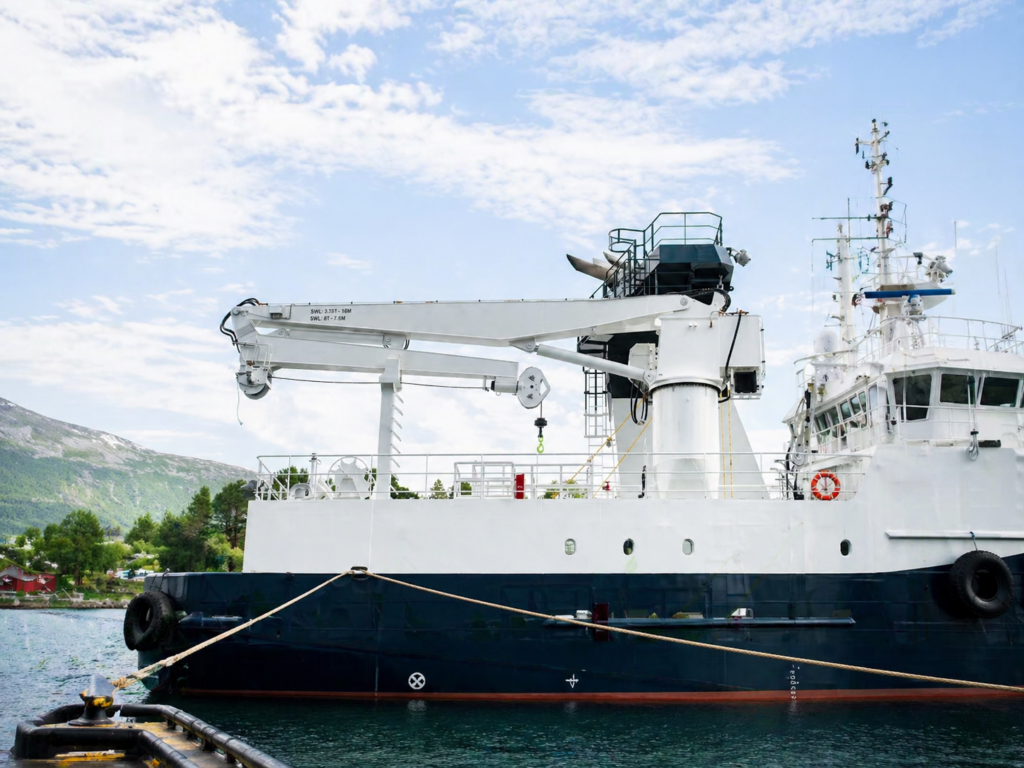
A crane does not work in isolation; it is a structural extension of the vessel’s hull. When buying or upgrading your equipment, you must evaluate how the crane’s weight and tipping moment interact with various vessel configurations.
| Vessel Type | Primary Crane Role | Stability Considerations |
| Flat-Top Barges | Construction, Piling, Salvage | High initial stability; vulnerable to offset center of gravity during heavy side lifts. |
| Offshore Supply Vessels | Cargo Transfer, Provisioning | High deck loading capacity; cranes must handle rapid dynamic sea-state adjustments. |
| Shipyards & Workboats | Maintenance, Equipment Deployment | Highly restricted space; requires ultra-compact footprint with high torque slewing. |
To counteract the rolling forces generated during heavy marine lifting operations, larger deck cranes interface with the ship’s internal ballast water systems. For smaller, specialized workboats and pontoon barges, integrated hydraulic marine outriggers are deployed directly to the seabed or structural supports to stabilize the platform, ensuring the crane never pushes the vessel beyond its safe trim and heel limits.
5. The Dual-Purpose Fleet: Cross-Evaluating Truck-Mounted Cranes for Marine Applications
A common question from fleet managers, construction companies, and equipment purchasers is whether standard truck-mounted cranes can be adapted for marine use. In infrastructure projects involving ports, coastal bridges, and shallow inland waterways, buying high-end, dedicated marine units can be cost-prohibitive. Consequently, buyers often search for cost-effective truck-mounted cranes for sale to modify for dockside or barge work.
Can you mount a heavy-duty hydraulic truck-mounted crane directly onto a floating platform? Yes, but with strict engineering modifications:
1. Chassis Elimination vs. Pedestal Mounting: Instead of leaving the crane attached to a standard truck chassis, the upper crane structure is often unbolted and welded onto a heavily reinforced steel pedestal secured directly to the barge’s structural bulkheads.
2. De-rating the Load Capacity: Because land-based truck-mounted cranes are engineered for solid, non-yielding ground, their standard load charts are invalid at sea. When used on a floating deck, the crane’s maximum capacity must be derated—often by 30% to 50%—to account for the dynamic listing forces of the water.ing the initial selection process.
6. B2B Procurement: Key Specifications for Commercial Buyers
For international contractors, equipment dealers, and shipyards, specifying the correct parameters during the Request for Proposal (RFP) stage prevents costly import errors and project delays.
• Specify Your Sea State Requirements: Never buy a deck crane based purely on its static maximum capacity. Demand the manufacturer provide a dynamic marine load chart rated for your expected operating conditions (e.g., Sea State 1, 2, or 3).
• Verify Classification Society Compliance: Ensure the design, welding standards, and material composition comply with international maritime classification societies such as Bureau Veritas (BV), American Bureau of Shipping (ABS), or DNV GL. (Local certification requirements: Data Pending Confirmation).
• Logistics & Component Modularization: If you are importing a crane to install on a local chassis or custom vessel deck, confirm if the manufacturer provides fully assembled testing or modular component kits (crane structure, valves, winch, and HPU separate) to minimize international ocean freight costs.
Conclusion
Deploying heavy lifting equipment on a marine deck requires balancing raw lifting power with delicate marine stability. From compact, space-saving knuckle boom cranes designed for tight workboats to robust telescopic boom cranes engineered for high-reach deep-water winching, matching the machine to the marine environment is vital.
For B2B buyers looking to optimize project budgets, analyzing how industrial lifting equipment operates on deck reveals whether a specialized marine unit is required or if a modified hydraulic truck-mounted crane can be safely integrated into your shallow-water fleet. Work closely with qualified marine engineers to verify your structural calculations, match your hull dimensions, and ensure your deck equipment delivers reliable service for years to come.