
Introduction
In the global heavy machinery procurement and truck body building sectors, mounting a high-performance crane onto a truck chassis involves far more than basic mechanical bolting. When browsing truck-mounted cranes for sale, many buyers focus exclusively on the crane’s maximum lifting capacity and boom length, while overlooking the vital “power bridge” between the chassis and the crane: the Power Take-Off (PTO).
A torque mismatch in the power take-off system is a silent killer that frequently forces newly deployed vehicles off the road for major overhauls. For international construction contractors, truck body builders, and equipment dealers, understanding and solving this technical bottleneck is critical to ensuring vehicle safety, legal compliance, and maximizing fleet Return on Investment (ROI).
1. The Mechanics: What is PTO Torque Mismatch?
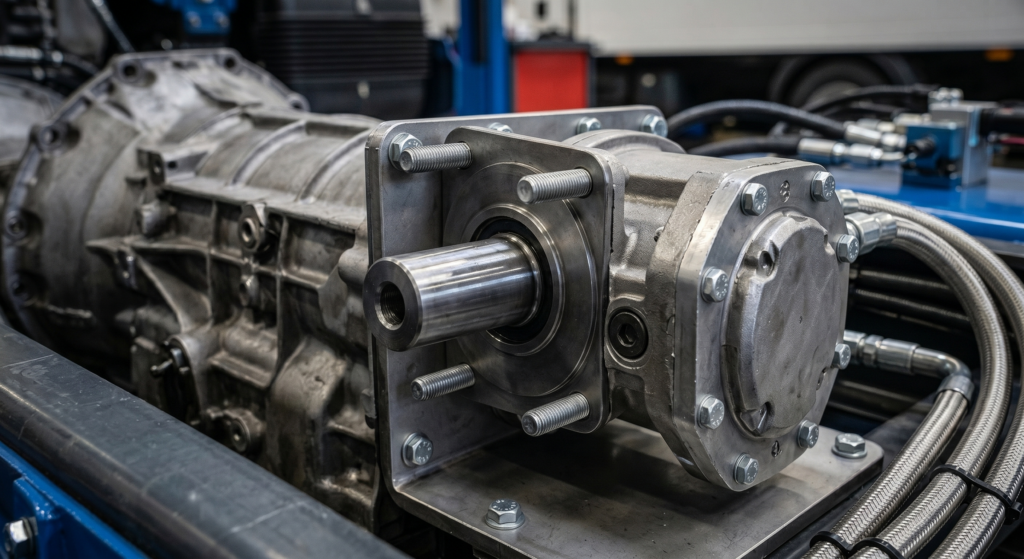
A truck chassis’ engine and transmission are primarily engineered for vehicle propulsion. When the truck is stationary and the crane’s hydraulic system needs to be activated, a PTO must be engaged on the transmission. The PTO transfers mechanical energy from the engine into torque, which in turn drives the crane’s hydraulic pump.
This torque mismatch typically occurs under two extreme conditions:
• Insufficient PTO Rated Torque: The selected PTO cannot withstand the reverse resistance torque generated by the hydraulic pump under heavy-duty operations (such as lifting maximum tonnage). This leads to sheared PTO internal gears or catastrophic damage to the transmission countershaft.
• Incorrect Speed and Gear Ratios: The output speed of the PTO is either too high or too low, causing the hydraulic pump to operate outside its optimal duty cycle, resulting in system overheating and a drop in lifting power.
2. Symptoms: 3 Common Field Indicators of PTO Torque Mismatch
During modification testing or real-world job site operations, a flawed vehicle integration setup usually manifests through three high-frequency symptoms:
• Abnormal Spikes in Hydraulic Oil Temperature: Whether operating knuckle boom cranes or telescopic boom cranes, an incorrect match between PTO speed and pump displacement creates severe backpressure or cavitation within the hydraulic circuit. The hydraulic oil can exceed 80°C in a short period, directly baking and destroying the crane’s internal core seals.
• Engine Stalling or Extreme Vibration Under Heavy Loads: When the crane attempts to lift its rated capacity, the hydraulic pump pressure instantly peaks (typically between 280 to 320 Bar). If the chassis engine lacks sufficient low-end torque at the specific PTO output speed, the entire vehicle will stall, or worse, suffer irreversible torsional fatigue damage to the gearbox housing.
• Intermittent Boom Movements and Erratic Shaking: Unstable power output prevents the proportional valves from receiving a steady flow of oil. Consequently, when the operator attempts high-precision micro-movements, the crane boom shakes violently, introducing severe safety hazards to the job site.
3. The Solutions: A 4-Step Framework to Ensure Seamless Crane and Truck Chassis Integration
To achieve a flawless fusion between hydraulic truck-mounted cranes and their chassis, truck body engineers must follow a strict system integration process:
• Step 1: Accurately Match the Hydraulic Pump’s Peak Absorbed Torque
Never size a system based purely on the crane’s required flow rate. Engineers must calculate the theoretical absorbed torque of the hydraulic pump at maximum system pressure using the standard engineering formula

• Step 2: Optimize the Engine’s Operating RPM Range
Modern diesel chassis (such as Volvo, ISUZU, or MAN) have distinct economic torque plateaus. By adjusting the PTO’s internal gear ratio, engineers ensure that when the engine runs within its fuel-efficient, high-torque band (typically 1000–1200 RPM), the speed delivered to the hydraulic pump falls precisely within its optimal working range (usually 1200–1500 RPM).
• Step 3: Balancing Rigidity with Flexibility (Subframe Engineering)
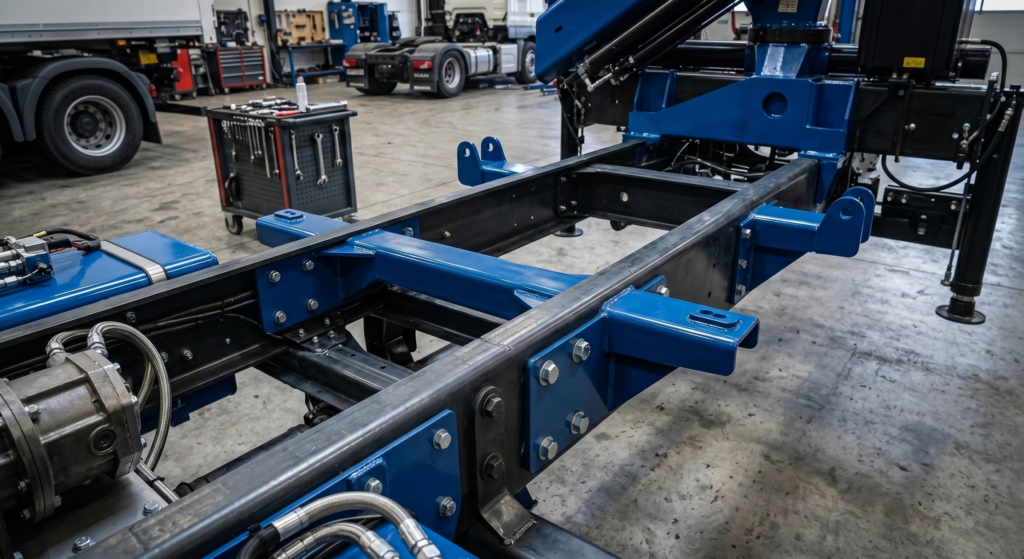
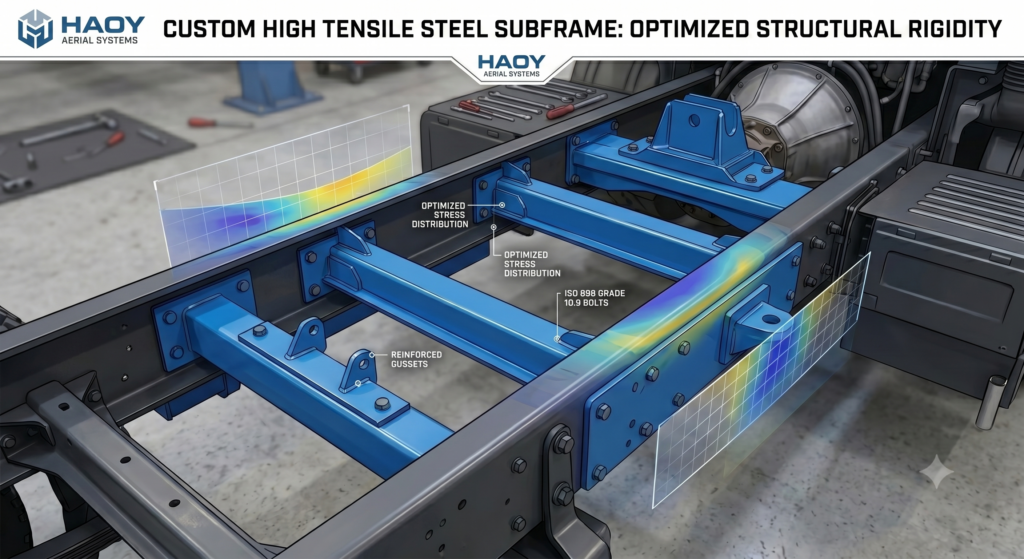
Immense torsional force eventually reacts against the truck’s chassis rails. During modification, a dedicated high-tensile steel subframe must be engineered to evenly distribute the massive torque generated by the crane base across the entire truck chassis. This prevents single-point stress concentration from cracking the gearbox casing or chassis beams.
4. Cross-Application: Extending Hydraulic Power Matching to Barges and Floating Platforms
Many international buyers look beyond land logistics, attempting to modify and install truck-mounted cranes onto coastal workboats, inland decks, or flat-top barges to serve as temporary marine cranes.In these cross-over applications, solving power mismatches becomes more complex. Because vessels lack truck transmissions and standard PTO interfaces, body builders must move away from chassis-driven power. Instead, they must deploy a standalone Self-Contained Hydraulic Power Unit (HPU) powered by a dedicated diesel engine or electric motor. In this scenario, power matching metrics shift from PTO torque to the continuous horsepower (HP) of the HPU and its cooling efficiency under dynamic marine sea states.
5. How to Mitigate Integration Risks When Sourcing Truck Cranes
If you are an engineering project official or an equipment dealer handling large-scale international procurement, ensure you clarify the following three points in your Request for Proposal (RFP) before placing an order with a direct-factory manufacturer:
• Provide Complete Truck Chassis Spec Sheets: Always hand over the exact transmission model, countershaft positions, and engine speed-torque curves of your locally sourced trucks to the crane manufacturer.
• Demand Integrated Hydraulic Matching Calculations: Require the manufacturer’s technical team to provide an official PTO selection recommendation sheet, explicitly detailing the proposed pump displacement (cc/rev) and rated working pressure.• Prioritize Global Standardization: Ensure that the PTO and pump interfaces adhere to international standards (such as ISO 4-bolt flanges or DIN 5462 involute splines). This guarantees that even if the equipment is exported to the Middle East, South America, or Africa, local workshops can easily source replacement parts, significantly lowering the Total Cost of Ownership (TCO).
Conclusion
A successful truck crane delivery depends 50% on the structural steel and hydraulic valves of the crane itself, and 50% on the quality of its integration with the chassis. PTO torque matching is the exact engineering pivot point that determines whether a machine becomes a highly productive fleet asset or a high-maintenance liability. By auditing torque specs, optimizing gear ratios, and integrating robust subframes, fleet operators and procurement managers can unlock the true lifting potential of their machinery—ensuring every heavy lift is as steady as a rock.