
Introduction
Modern urban construction has shifted dramatically toward interior retrofitting, high-density infill projects, and complex architectural installations. In these environments, traditional mobile or tower cranes face insurmountable barriers: they are too massive to position near the structure, exceed floor loading capacities, or cannot navigate narrow access corridors. This structural bottleneck has fueled the rapid adoption of the spider crane (also known as a mini crawler crane).
For general contractors, glazing specialists, and machinery rental fleets, sourcing a spider crane is no longer a niche luxury—it is a core operational requirement. Engineered with a compact track-mounted chassis and spider-like stabilizing outriggers, these versatile machines deliver high-tonnage lifting directly inside finished buildings, enclosed atriums, and elevated floor slabs. However, selecting the ideal spider crane requires a rigorous technical evaluation of physical passability, load dynamics, power configurations, and structural floor limits.
1. Core Technical Features That Define a Commercial Spider Crane
Compact Footprint & Passability
The defining engineering achievement of a mini crawler crane is its ultra-compact transport geometry. When stowed, the boom, winch, and outriggers fold neatly into a narrow profile, often measuring under 800 mm (31.5 inches) in width. This allows the crane to traverse standard single or double doorways, maneuver through commercial hallways, and enter freight or passenger elevators to access upper floors or basements without structural modification.
Variable Outrigger Configurations & Stability
Indoor lifting environments rarely offer spacious, level ground. Spider cranes overcome this using multi-stage, angle-adjustable outriggers. These hydraulic legs can be deployed individually in asymmetric footprints to bypass interior columns, HVAC ducts, or pit edges. Advanced stability control systems continuously monitor outrigger angles and extension lengths, automatically calculating safe moment limits based on the active footprint.
Rubber Tracks & Low Ground Pressure
Unlike heavy wheeled or steel-tracked machinery, spider cranes utilize non-marking rubber tracks that distribute machine mass evenly across a wide contact area. This reduces ground bearing pressure to levels well within the structural safety margins of elevated concrete slabs, raised access flooring, tile, and marble surfaces, eliminating expensive surface reinforcement or floor damage repairs.
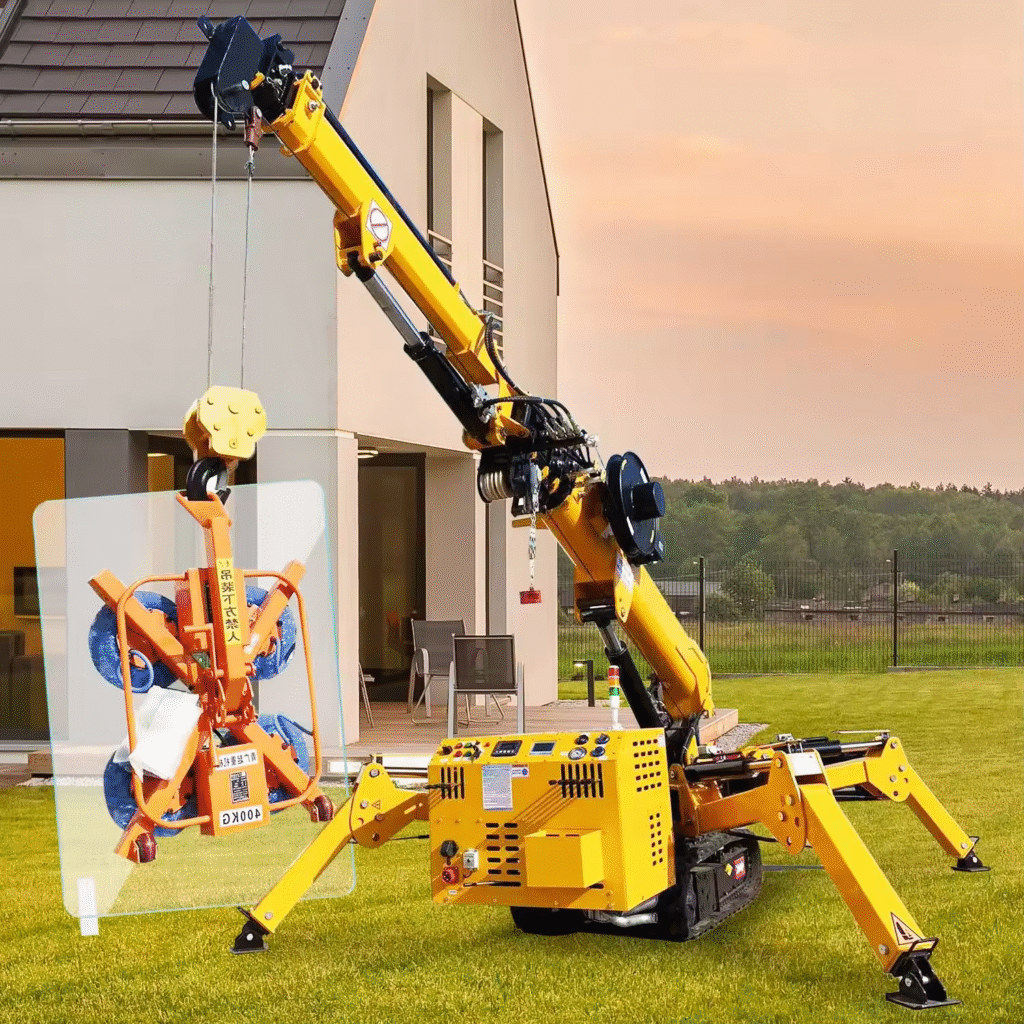
2. How to Choose the Right Spider Crane Capacity for Your Projects
1-3 Ton Mini Spider Cranes: Indoor & Glazing Applications
Lightweight mini cranes in the 1 to 3-ton class are the industry standard for indoor glass curtain wall installation, atrium maintenance, and light HVAC placement. When paired with specialized hydraulic glass vacuum lifters, a 3-ton spider crane provides precise millimeter-level control for positioning heavy double-glazed panels in tight interior angles.
5-8 Ton Heavy-Duty Spider Cranes: Structural Steel & Industrial Maintenance
For heavy industrial plant maintenance, structural steel erection, and transformer handling inside power stations, heavy-duty 5 to 8-ton spider cranes deliver necessary muscle. These units feature longer telescopic booms and fly jibs, enabling high-hook heights while maintaining a remarkably small base footprint.
Understanding the Load Chart in Narrow Setups
A critical factor in spider crane procurement is evaluating the Load Moment Indicator (LMI) chart under restricted conditions. When outriggers cannot be fully extended due to interior walls, the crane’s rated lifting capacity drops proportionately. Buyers must review rated load charts across mid-extension and minimum-extension outrigger setups to ensure the machine maintains required working capacities at maximum operational radius.
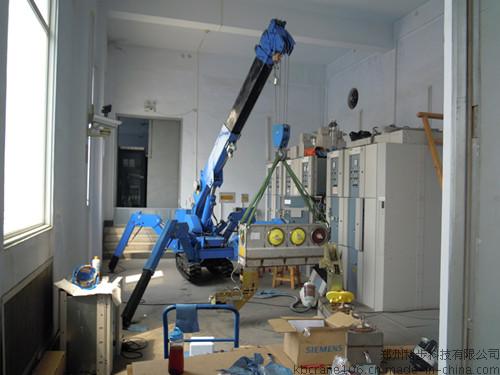
3. Power Source Options: Dual-Energy Systems for Zero-Emission Work
Diesel/Gasoline Engine for Outdoor Rough Terrain
For initial site setup, outdoor staging yards, and rough-terrain access, internal combustion engines (diesel or petrol) provide maximum continuous torque and rapid transit speeds without relying on electrical grid infrastructure.
Electric/Battery Power Pack for Indoor Zero-Emission Operations
Indoor construction sites, operational hospitals, food processing facilities, and commercial malls enforce strict zero-emission and noise-level mandates. Leading spider crane manufacturers solve this by offering dual-power systems—integrating a standard engine with a 380V/415V electric motor or high-capacity lithium battery pack. This enables seamless plug-in zero-emission operation indoors while retaining engine power for outdoor transport.
4. Evaluating Manufacturers & Total Cost of Ownership (TCO)
International Safety Certifications (CE, OSHA, ISO)
When importing machinery or expanding a rental fleet, ensure the spider crane carries validated international compliance certifications, including European CE (EN13000 for crane safety), OSHA compliance, and ISO 9001 manufacturing quality standards. Missing certifications can cause customs seizures, site access rejections, or severe insurance liabilities.
Wireless Remote Control Systems
Precision indoor lifting requires optimal line-of-sight. High-grade spider cranes feature multi-function proportional wireless radio remote controls equipped with real-time digital displays. This allows the operator to walk alongside the load, inspect clearances, and execute precise movements in blind spots.
Spare Parts Availability & Transport Logistics
Evaluate the manufacturer’s global logistics and spare parts support network. Key maintenance components—such as hydraulic cylinder seals, rubber track replacements, wireless remote modules, and LMI sensors—must be readily available. Furthermore, verify that the crane’s dimensions allow standard container shipping (20ft or 40ft GP) to minimize international freight costs.
Conclusion
Investing in the right spider crane unlocks access to high-margin, space-restricted lifting projects that standard cranes simply cannot execute. By matching physical passability, floor load thresholds, dual-power versatility, and certified safety electronics to your operational requirements, fleet owners build a distinct competitive advantage. A well-selected mini crawler crane delivers rapid project execution, reduces labor costs, and provides an exceptionally strong return on investment across decades of indoor and urban construction service.
FAQs
Q1: What is a spider crane and where is it used?
A: A spider crane (mini crawler crane) is a compact lifting machine with a telescopic boom, rubber tracks, and four spider-like outriggers. It is designed for tight-access lifting, indoor construction, curtain wall installation, and rooftop operations where traditional cranes cannot enter.
Q2: Can a spider crane fit through a standard doorway?
A: Yes. Most 1-ton to 3-ton spider cranes feature a stowed width of less than 800mm (31.5 inches), allowing them to pass through standard single or double doors and enter passenger elevators.
Q3: Why are rubber tracks used on spider cranes instead of steel tracks?
A: Rubber tracks distribute machine weight evenly, reducing ground bearing pressure. This prevents damage to sensitive indoor flooring like tiles, marble, and concrete, while enabling safe operation on weight-restricted floors and roofs.
Q4: Can spider cranes be operated indoors safely?
A: Yes, when equipped with an electric motor or lithium-battery pack (dual-power option). This allows zero-emission and low-noise operation inside closed buildings, hospitals, and shopping malls.
Q5: How do I transport a spider crane to a job site?A: Due to their compact dimensions and relatively light weight, smaller spider cranes can be easily transported on a standard flatbed trailer, towed behind a pick-up truck, or transported inside a regular shipping container for international delivery.