
Introduction
In the global heavy logistics, utility infrastructure, and truck body building industries, the truck mounted crane is highly valued for its ability to transform a standard commercial vehicle into a self-loading, high-efficiency material handler. For fleet managers, municipal buyers, and construction contractors browsing truck mounted cranes for sale, it is tempting to assume that any industrial crane can be unbolted and fitted onto any available truck chassis.
However, from an engineering perspective, the definitive answer is no—a truck mounted crane cannot be installed on just any truck. Attempting to couple an unverified crane with an incompatible truck chassis leads to structural failure, cracked frame rails, destroyed gearboxes, and deadly stability risks during operation. Mounting an industrial crane is a precise science governed by rigid mechanical, hydraulic, and structural laws. This technical guide breaks down the four non-negotiable engineering variables that dictate whether a truck and a crane can safely work together.
1. Gross Vehicle Weight Rating (GVWR) & Payload Math
Every commercial vehicle chassis is manufactured with a strict legal and structural limit known as the Gross Vehicle Weight Rating (GVWR). This number represents the absolute maximum weight of the entire vehicle, including the chassis, fuel, fluids, driver, passengers, bodywork, cargo, and any mounted equipment.
When a fleet operator installs a hydraulic truck mounted crane, the deadweight of the crane unit—including the boom assembly, outriggers, control valves, counterweights, and hydraulic oil—directly consumes a massive portion of the truck’s available payload capacity. For example, if a 4×2 light-duty commercial truck has a total remaining payload capacity of 3 tons, installing a heavy-duty 4-ton knuckle boom crane is physically and legally impossible.
Even if the crane fits within the overall weight limits, engineers must execute precise Axle Load Distribution Calculations. A crane positioned directly behind the truck cab shifts massive weight onto the front steer axle. If the front axle rating is exceeded, steering mechanics fail, tires wear prematurely, and braking distances increase dangerous limits. Conversely, if a crane is rear-mounted, it acts as a massive counter-lever, lifting the front steering tires off the road surface when driving uphill.
2. Subframe Engineering and Torsional Resistance
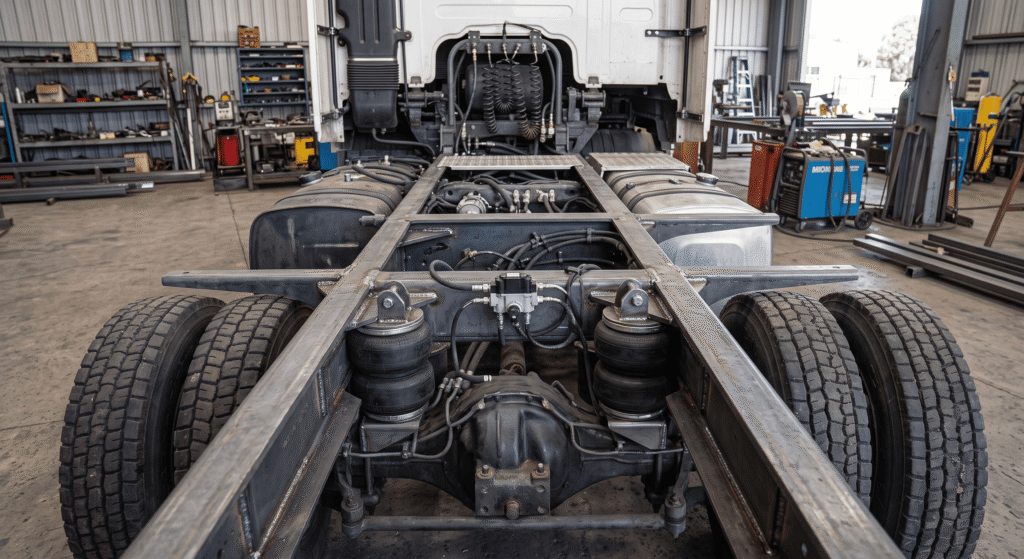
Standard land-use truck chassis rails are designed primarily to handle vertical bending moments—the weight of a flatbed load pushing straight down while driving. However, when a knuckle boom crane or telescopic crane lifts a heavy load at a horizontal radius, it generates severe torsional stress (twisting forces).
If a crane is bolted directly to standard truck chassis rails, these intense twisting forces will bend, warp, and crack the truck’s frame within a few duty cycles. To make an installation work, body modification plants must design and weld a dedicated high-tensile steel subframe. This subframe acts as a secondary structural skeleton, running underneath the primary chassis rails to absorb the rotational forces and distribute the load evenly across the vehicle platform. The truck’s chassis frame must have the exact longitudinal flatness and steel thickness to allow this subframe integration without hitting fuel tanks, exhaust systems, or suspension brackets.
3. Power Take-Off (PTO) Transmission Compatibility
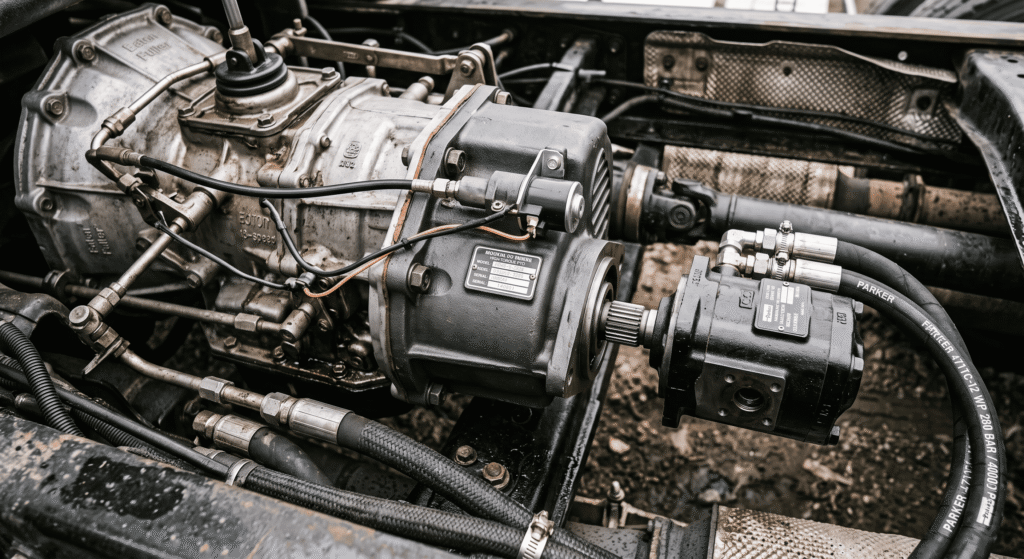
A crane requires massive fluid power to run its winches, cylinders, and slewing gear. This energy is generated by a high-pressure hydraulic pump, which relies on the truck engine for its primary power. The physical link that delivers this mechanical energy is the Power Take-Off (PTO) unit, which bolts directly onto the truck’s gearbox.
This introduces a critical barrier: not all truck transmissions are engineered to accommodate a crane-grade PTO.
• Torque and Gear Limitations: The truck’s gearbox must feature an uninhibited PTO aperture (opening) with internal gears that match the torque requirements of the crane’s hydraulic pump. If the pump absorbs 400 Nm of torque under full load, but the truck’s transmission output gear is only rated for 250 Nm, the internal gears will shear, causing a complete mechanical breakdown.
• Engine RPM Synchronization: The PTO must match the engine’s torque curve. The setup must allow the truck engine to operate at its peak fuel-efficient RPM plateau while delivering the exact rotational speed needed by the hydraulic pump to prevent cavitation and fluid overheating.
4. Wheelbase, Cab Clearance, and Stability Footprints
Beyond the internal mechanical specifications, the geometric dimensions of the truck must match the spatial requirements of the crane.
First, the crane requires a safe rotation footprint. If the truck cab is too tall or features an oversized sleeper berth, it can block a knuckle boom crane from folding down into its compact transport position.
Second, the truck’s wheelbase (the distance between the front and rear axles) dictates the vehicle’s tipping line. When the crane boom swings outward to lift a load over the side of the truck, the vehicle relies on its hydraulic outriggers (stabilizers) to prevent a rollover. If the truck chassis width is too narrow, or if its crossmembers prevent the outrigger beams from extending to their maximum required structural width, the overall setup will fail international stability tests.
5. Fleet Modification Workshop
If your company is sourcing direct-factory equipment or managing fleet upgrades across multiple truck brands (such as Volvo, ISUZU, MAN, or Scania), use this quick checklist to ensure total chassis-to-crane integration before buying:
1. Request a Complete Truck Chassis Spec Sheet: Secure the transmission code, axle load limits, engine torque curves, and 3D CAD frame layouts from the truck dealer.
2. Verify the PTO Interface Code: Check if the transmission matches global standards (such as ISO 4-bolt or DIN 5462 configurations). This ensures standard hydraulic pumps can lock into place smoothly.
3. Cross-Evaluate Marine Applications: If your long-term plans involve moving the crane onto floating platforms, barges, or ship decks, ensure the unit can handle independent Hydraulic Power Unit (HPU) inputs rather than relying solely on truck PTO outputs.
Conclusion
Ultimately, a truck mounted crane is an advanced engineered system, not a generic universal bolt-on accessory. An indiscriminate pairing of a truck and crane creates immediate structural vulnerabilities, accelerated mechanical wear, and legal liability risks on the job site.
By auditing Gross Vehicle Weight ratings, evaluating transmission PTO torque compatibility, designing high-tensile subframes, and verifying geometric stability footprints, procurement managers protect their machinery assets and ensure operational safety. Taking the time to execute these technical checks balances your fluid power loop, secures your chassis infrastructure, and ensures your heavy lifting asset provides a reliable return on investment for years to come.