
In global commercial transport and material handling, the knuckle boom crane has earned a place in utility, forestry, construction, and logistics fleets because it is more than a lifting device. With the correct attachment, one truck can lift, winch, grab, rotate, and position materials across very different jobs.
Attachment selection affects three critical engineering values: auxiliary hydraulic flow, system pressure, and effective lifting capacity at the tool. This guide compares winches, grapples, rotators, and quick couplers so dealers, body builders, and fleet operators can match each attachment to the crane and the work.
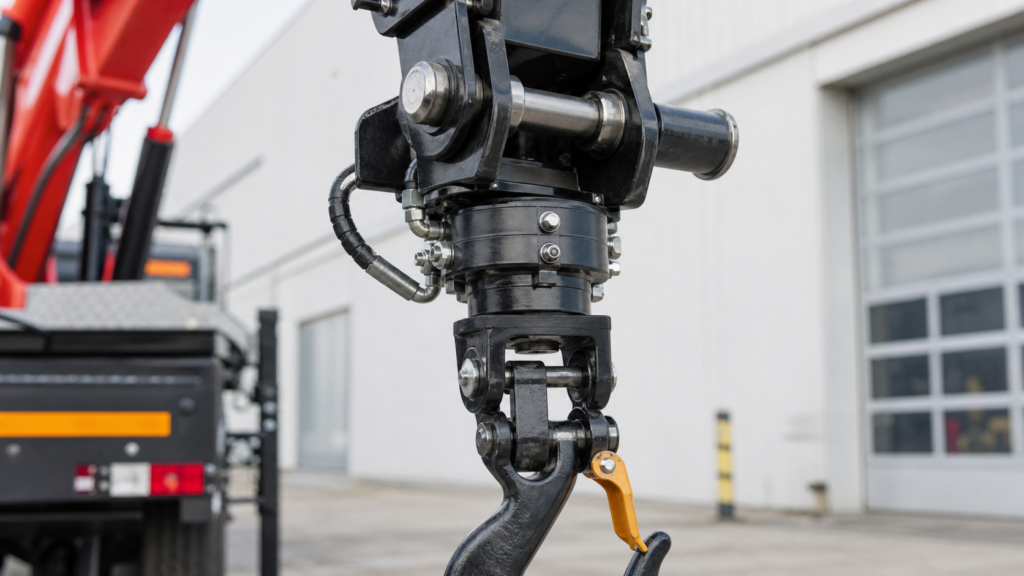
What Attachments Can a Knuckle Boom Crane Carry?
A knuckle boom crane’s hydraulic circuit, boom-tip geometry, and load rating determine which attachments it can carry. Most tools fall into three groups:
- Lifting attachments: hooks, hydraulic winches, and rotator-equipped hooks for vertical lifting and accurate placement.
- Grabbing attachments: log grapples, grapple saws, scrap grapples, and clamshell buckets for timber, demolition material, and aggregate.
- Specialized tools: pallet forks, personnel baskets, pole grabs, augers, and hydraulic hammers for task-specific operations.
Most attachments connect through a pin-mounted or quick-coupler interface. This allows one crane to handle logs during one shift and place a transformer during another, provided the auxiliary hydraulic circuit and the crane’s rated capacity support the selected tool. For a broader introduction to the crane design, see our guide to knuckle boom crane applications and advantages.
Winch Attachments for Controlled Vertical Lifting
An articulated boom excels at horizontal reach and over-side placement, but its folding geometry is less efficient for a straight vertical lift. A hydraulic winch converts hydraulic power into controlled cable movement and lets the operator raise or lower a load without changing the boom geometry.
- Boom-tip winches: Mounted near the outer boom section for direct vertical lifting independent of boom angle. Typical line pull ranges from 1 to 5 metric tons, depending on crane class.
- Base or main winches: Used where greater line pull or longer rope storage is required, usually together with rope guides and a hook block.
- Specifications to match: Line pull, rope length, rope diameter, drum capacity, and line speed must suit both the load and the crane’s load chart.
Utility and service fleets often use a winch-equipped knuckle boom for transformers, poles, pumps, and HVAC units. The articulated boom provides horizontal positioning while the winch provides controlled vertical movement. The allowable load must never exceed either the winch rating or the crane rating at the actual working radius.
Grapple Attachments for Wood, Scrap, and Bulk Materials
A grapple converts the crane into a repetitive material handler and reduces the need for workers to guide loose materials by hand.
- Log grapples: Rotating or fixed-jaw tools selected by jaw opening, closing force, and the diameter of the timber. Applications range from smaller firewood to commercial logs over 30 inches in diameter.
- Grapple saws: Combine a timber grapple with an integrated hydraulic saw so the operator can grip, cut, and place material in one controlled cycle.
- Scrap grapples and clamshell buckets: Heavy-duty tools for scrap metal, demolition debris, soil, and aggregate. Wear-resistant materials are important in continuous abrasive service.
The most important selection values are jaw opening, closing force, tool weight, and hydraulic demand. Tool weight is carried at the end of the boom, so a heavier grapple reduces the remaining payload throughout the working envelope.
Rotators and Quick Couplers
Rotators and couplers determine how accurately an attachment can be positioned and how quickly the crane can change between jobs.
- Hydraulic rotators: Rotate a grapple, hook, or other tool through 360 degrees so the operator can align the load without repositioning the truck. Specify the rotator by payload rating and rotation torque in newton-metres.
- Quick couplers: Pin-lock or hydraulic systems that reduce attachment changeover from a lengthy manual process to roughly 5–10 minutes when the system is correctly configured.
Check that the coupler locking mechanism matches the attachment interface. The rotator through-bore, swivels, hoses, and pressure lines must also match the crane’s auxiliary hydraulic routing. Lock indicators and a clear verification procedure help prevent incomplete coupling.
Attachment Selection Reference
| Attachment | Primary function | Typical applications | Key specification | Capacity effect | Hydraulic demand |
|---|---|---|---|---|---|
| Winch | Controlled vertical lifting | Utility, HVAC, telecom | Line pull, rope length, and line speed | Moderate | Medium, with sufficient system pressure |
| Grapple | Grabbing and bulk handling | Forestry, scrap, construction | Jaw opening, closing force, and tool weight | High because of tool weight | High flow and pressure |
| Rotator with hook or tool | Load orientation and accurate placement | General lifting and material handling | Rotation torque and payload rating | Moderate | Low to medium flow |
Hydraulic and Capacity Checks
Adding an attachment changes both the hydraulic demand and the structural loading of the crane. Complete these checks before approving a configuration:
- Auxiliary hydraulic circuit: Confirm that the truck PTO and crane pump provide the flow and pressure specified by the tool manufacturer. A grapple usually needs continuous flow; an undersized circuit can cause slow operation, weak grip, and overheating.
- Capacity at the attachment point: Subtract the attachment, rotator, coupler, hook block, and rigging weight from the allowable capacity. Check the result at the actual radius and boom position, not at the bare hook. Our guide on how to read a crane load chart explains the key values.
- PTO and pump sizing: A hydraulic circuit originally specified for crane movement alone may need a different pump arrangement, a flow divider, or a separate auxiliary circuit for a winch or grapple.
- Hose routing and protection: Check hose length through the full articulation range and protect lines from pinching, abrasion, and excessive bending.
For example, a 500 kg grapple can reduce effective capacity by more than 500 kg at an extended working radius because its mass acts at the boom tip and becomes part of the total suspended system.
Attachment Specification Checklist
- Define the dominant material and lifting task.
- Record the maximum load, working radius, and required lift height.
- Confirm attachment self-weight and mounting dimensions.
- Match required hydraulic flow and pressure to the available circuit.
- Verify the coupler, pin size, hose routing, and electrical controls.
- Recalculate capacity across the intended operating envelope.
- Confirm inspection, lubrication, and maintenance procedures.
Choose the Right Tool for the Job
A knuckle boom crane becomes significantly more versatile when its attachments are engineered as part of the complete system. Winches add controlled vertical movement, grapples support repetitive material handling, rotators improve load orientation, and quick couplers simplify changeover between tasks.
The safest configuration is one in which the attachment, crane, truck PTO, hydraulic circuit, mounting interface, and load chart have been checked together. Contact the HAOY technical team for the attachment compatibility matrix, auxiliary hydraulic requirements, and capacity re-rating information for your crane model.
Frequently Asked Questions
What attachments can a knuckle boom crane use?
Common options include hydraulic winches, log grapples, grapple saws, scrap grapples, clamshell buckets, pallet forks, rotators, personnel baskets, pole grabs, augers, and hydraulic hammers. Compatibility depends on rated capacity, the mounting interface, and available hydraulic flow and pressure.
Why add a winch to a knuckle boom crane?
A winch provides straight-line cable movement for lowering or raising loads while the articulated boom controls horizontal position. Depending on crane class, boom-tip winches commonly provide 1–5 metric tons of line pull.
What size grapple is suitable for logs?
Match the grapple’s jaw opening and closing force to the timber diameter and shape. Also check the grapple’s self-weight against the crane load chart at every intended working radius.
How do I choose between a winch and a grapple?
Use a winch when controlled vertical lifting and placement are the primary tasks. Use a grapple for repetitive handling of timber, scrap, debris, or aggregate. A compatible quick coupler can support both tools on a mixed-duty truck.
Does an attachment reduce lifting capacity?
Yes. The attachment, rotator, coupler, and rigging all consume part of the crane’s allowable capacity. Their combined weight must be deducted before determining the net load at the actual radius.
Can an attachment be added to an existing crane?
Often, yes. First verify auxiliary hydraulic flow and pressure, PTO and pump sizing, the boom-tip mounting interface, hose routing, control compatibility, and the revised capacity chart. Manufacturer engineering approval is recommended before operation.