
A truck-mounted crane depends on clean, cool and correctly pressurized hydraulic oil. When contamination, heat or leakage is allowed to build up, lifting speed falls, components wear and unplanned downtime follows. This practical checklist gives operators and fleet managers a repeatable maintenance routine, while leaving model-specific limits to the crane manufacturer’s manual.
Quick answer: Inspect the system before every shift, lubricate and check critical fasteners weekly, sample the oil correctly, change filters according to the restriction indicator or OEM schedule, and record every finding. Never work beneath a suspended load or open a pressurized hydraulic line.
Truck-Mounted Crane Hydraulic Maintenance Checklist
- Why hydraulic maintenance matters
- Daily pre-operation inspection
- Weekly and monthly maintenance
- Hydraulic fluid management
- Filter maintenance
- Troubleshooting warning signs
- Seasonal maintenance
- Frequently asked questions

Why Hydraulic Maintenance Matters
Hydraulic pumps, control valves, cylinders, motors and load-holding valves operate with small internal clearances. Dirt, water, aeration and overheated oil can damage those surfaces long before an operator sees a major loss of performance. A short inspection catches loose fittings, cracked hoses, damaged rod surfaces and low oil before a preventable fault becomes a major pump or cylinder repair.
For European loader cranes, BS EN 12999:2020+A1:2025 addresses loader-crane design and safety requirements. ISO 4413:2010 covers general rules and safety requirements for hydraulic systems, while ISO 4406:2021 defines the code used to report solid-particle contamination. These standards support good practice, but they do not replace the instructions for your exact crane.
Daily Pre-Operation Inspection: 10–15 Minutes
- Park and secure the vehicle. Use firm, level ground where possible. Retract and stow the boom, apply the parking brake, stop the engine and relieve stored hydraulic pressure as the manual directs.
- Check the oil level. Read the sight glass or dipstick with the crane in the specified position. A sudden drop can indicate an external leak or oil moving into an unintended part of the system.
- Look for leaks. Inspect the tank, pump, valve bank, hose ends, cylinders, slew system and outrigger circuits. Never use your hand to find a pinhole leak; high-pressure fluid can penetrate skin.
- Inspect hoses and pipes. Look for abrasion, exposed reinforcement, blistering, kinks, corrosion, flattened sections and contact with hot or moving parts.
- Inspect cylinder rods. Rods should be clean, smooth and free from rust, scoring or dents. Check wipers and gland areas for oil film that is becoming a drip.
- Listen during a controlled function test. Whining, knocking or uneven movement can indicate cavitation, air, restriction or incorrect oil viscosity.
- Test outriggers and controls. Confirm smooth extension and retraction, stable support, correct interlocks and predictable control response.
- Record defects. Note the hour-meter reading, oil level, indicator condition and any defect. Tag the crane out of service when a fault affects safe operation.
If you are reviewing a new installation or selecting equipment, see our truck-mounted crane range. Operators should also understand how hydraulic capacity relates to reach and load; our guide explains how to read a crane load chart.
Weekly and Monthly Maintenance
Weekly Tasks
- Grease boom pivots, linkage pins, cylinder pins, slew bearings and other points listed on the lubrication chart. Wipe fittings first so dirt is not pushed into the joint.
- Check accessible mounting bolts, hose clamps, guards and outrigger fasteners. Use only the specified torque and tightening sequence.
- Observe the oil through a clean sight glass. Darkening, haze, foam, burnt odor or visible particles require investigation.
- Check filter restriction indicators at normal operating temperature. Reset or replace an indicator only after its cause has been addressed.
- Clean the oil cooler and make sure airflow is not blocked by dust, leaves, plastic or bent fins.
Monthly Tasks
- Take an oil sample after the system has reached operating temperature, ideally from a dedicated live-zone sampling port. Do not scoop oil from the tank opening.
- Cycle each function under a controlled light load and inspect connections, valve sections and seals for leakage or unusual heat.
- Inspect electrical plugs, solenoids, pressure sensors and wiring near the valve bank for water entry, corrosion and damaged insulation.
- Check accumulator pre-charge only with the correct equipment and procedure. Accumulators store hazardous energy even after the engine is stopped.
- Compare faults and oil-analysis trends with the previous service record rather than relying on a single reading.
Hydraulic Fluid Management
Use the oil grade and performance specification stated by the crane manufacturer. ISO VG 32 and ISO VG 46 are common viscosity grades, but ambient temperature, pump design, duty cycle and approved additive package determine the correct choice. Do not mix products simply because their viscosity grades match; incompatible base oils or additives can cause foaming, seal problems or loss of performance.
Many fleets plan an oil change around 2,000–3,000 operating hours or one to two years. Treat that only as a planning range. The manufacturer’s schedule, oil condition, contamination results, operating temperature and warranty requirements govern the actual interval. Oil analysis can justify an earlier change or support safe use beyond a calendar interval.
How to Take a Useful Oil Sample
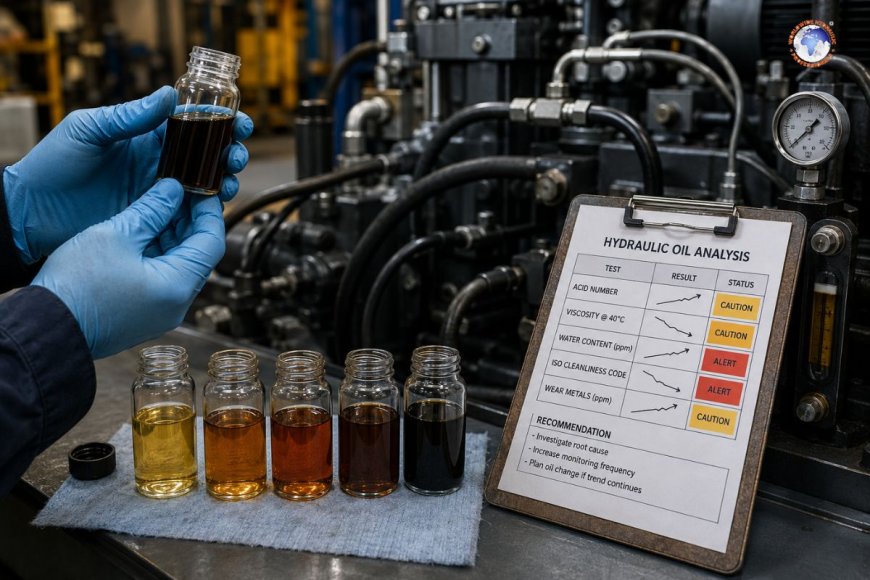
- Warm the system by operating it safely for about 30 minutes.
- Clean the sampling valve and surrounding area.
- Flush the sampling point into a waste container according to the sampling procedure.
- Fill a clean laboratory bottle without touching the cap or bottle interior.
- Label the sample with crane ID, hours, oil brand and grade, sample point, date and any recent top-up or repair.
- Track viscosity, water, particle count and wear metals over time.
An ISO 4406 cleanliness code such as 18/16/13 is a commonly discussed target for mobile hydraulic equipment, but it is not universal. Confirm the required code with the crane, pump and valve manufacturers and use a laboratory method that reports against the current ISO 4406 edition.
Filter Maintenance
A filter protects the system only when it has the correct micron rating, efficiency, flow capacity and bypass setting. Fit the OEM-approved element or a fully verified equivalent. A return-line filter may be scheduled around 500–1,000 hours, but a differential-pressure indicator, oil analysis and the manual provide better guidance than a generic interval.
- Replace a restricted filter promptly and investigate why it loaded early.
- Inspect and clean suction strainers at the oil-change interval if the design permits.
- Keep the reservoir breather clean and use the correct filtered or desiccant type for dusty or humid service.
- Clean around the housing before opening it. Cap hoses and ports immediately.
- Lubricate the new seal with compatible clean oil, install the element correctly and check for leakage after start-up.
- Never wash and reuse a disposable element unless the manufacturer expressly permits it.
Warning Signs and First Checks
| Symptom | Possible causes | Safe first checks |
|---|---|---|
| Slow or weak movement | Low oil, restricted suction, worn pump, relief valve issue | Check oil level and temperature; inspect restriction indicators; test pressure only by the approved procedure |
| Boom or load drifts | Cylinder bypass, load-holding valve leakage, contaminated control valve | Stop operation; secure the boom; have the holding circuit and cylinder tested |
| Whining or knocking | Cavitation, suction air leak, cold or incorrect-viscosity oil | Check oil level, suction connections and approved viscosity range |
| Oil overheats | Low oil, blocked cooler, constant relief operation, excessive internal leakage | Check level, cooler airflow and whether a control is failing to return to neutral |
| Foamy or milky oil | Air ingress, water contamination, poor return routing | Stop and sample the oil; inspect breather, suction lines and return flow |
| Jerky operation | Air, sticking valve, damaged seals, electrical fault | Follow the approved bleeding procedure; inspect valve, solenoid and wiring condition |
Do not compensate for slow movement by increasing relief pressure or adjusting valve settings without approved test equipment and specifications. That can overload structural and hydraulic components and may invalidate safety settings.
Seasonal and Climate-Specific Maintenance
Hot Weather
- Keep the cooler clean and verify the fan, thermostat and guards.
- Monitor actual reservoir temperature, especially during repeated lifts.
- Use only an approved higher-viscosity or high-viscosity-index oil when the manual permits it.
- Investigate constant relief-valve operation and internal leakage instead of accepting chronic heat.
Cold Weather
- Use the approved low-temperature viscosity grade and allow a controlled warm-up.
- Operate functions slowly and without load until response is smooth.
- Inspect seals and hoses more frequently because cold materials can stiffen.
- Never accelerate warm-up by holding a control continuously over relief.
Dusty or Humid Conditions
- Inspect breathers and filter indicators more often.
- Keep couplers, caps and transfer containers sealed and clean.
- Consider desiccant breathers where humidity and condensation are persistent.
- Shorten the sampling interval so contamination is found before it causes wear.
Frequently Asked Questions
How often should truck-crane hydraulic oil be changed?
Follow the model-specific manual. A planning range of 2,000–3,000 hours or one to two years is common, but severe service, high temperature, contamination or warranty terms can require a shorter interval. Oil analysis helps establish the right interval for a fleet.
What hydraulic oil should I use?
Use the OEM-approved specification and viscosity grade for the expected temperature range. ISO VG 32 or 46 may be specified, but the grade alone does not confirm compatibility.
What does an ISO 4406 code mean?
It is a three-number code representing ranges of particle counts at defined particle sizes. A lower code generally indicates cleaner oil. Use the target specified by the component or crane manufacturer.
When should I replace the hydraulic filter?
Replace it at the OEM interval or when the restriction indicator calls for service. An early restriction warning deserves investigation because it may reveal oil degradation, ingressed dirt or component wear.
Why is the hydraulic system overheating?
Common causes include low oil, a blocked cooler, incorrect viscosity, continuous relief-valve flow and internal leakage. Measure temperature and pressure using the approved test procedure rather than changing adjustments by trial and error.
Can universal tractor fluid be used?
Only when the crane manufacturer explicitly approves that product category and specification. An unapproved fluid can affect pumps, valves, brakes, seals and warranty coverage.
How should I plan an annual maintenance budget?
Base it on operating hours, duty severity, oil-analysis history, planned filter and fluid changes, hose age, inspection requirements and prior repairs. Fleet history and the OEM schedule are more reliable than a universal percentage of purchase price.
The Bottom Line
Effective hydraulic maintenance is disciplined rather than complicated: keep the oil clean and cool, stop leaks early, protect the system during service and document what changes over time. A consistent 10-minute inspection can prevent far longer downtime.
HAOY supports truck-mounted crane owners with model-specific maintenance guidance. For specifications, service documentation or help selecting a crane for your duty cycle, contact the HAOY team.