
Introduction
In international infrastructure maintenance and municipal procurement, the metrics for evaluating mobile elevating work platforms (MEWPs) are shifting. For telecom sub-contractors, utility fleet managers, and rental companies, sourcing a lifting asset is no longer just about reaching the maximum height; it is about reaching that height within a highly restricted, congested urban footprint.
Standard large-scale telescopic boom lifts excel in wide-open greenfield industrial sites. However, when deployed in historical city centers, narrow alleys, or busy multi-lane highways, their physical bulk creates immediate logistical gridlocks. This operational bottleneck is exactly why global B2B buyers are looking closer at the engineering profiles of a specific asset class: the compact articulated truck mounted MEWP. This guide breaks down the structural physics, fleet ROI, and chassis integration variables that make this machine the definitive solution for modern urban access projects.
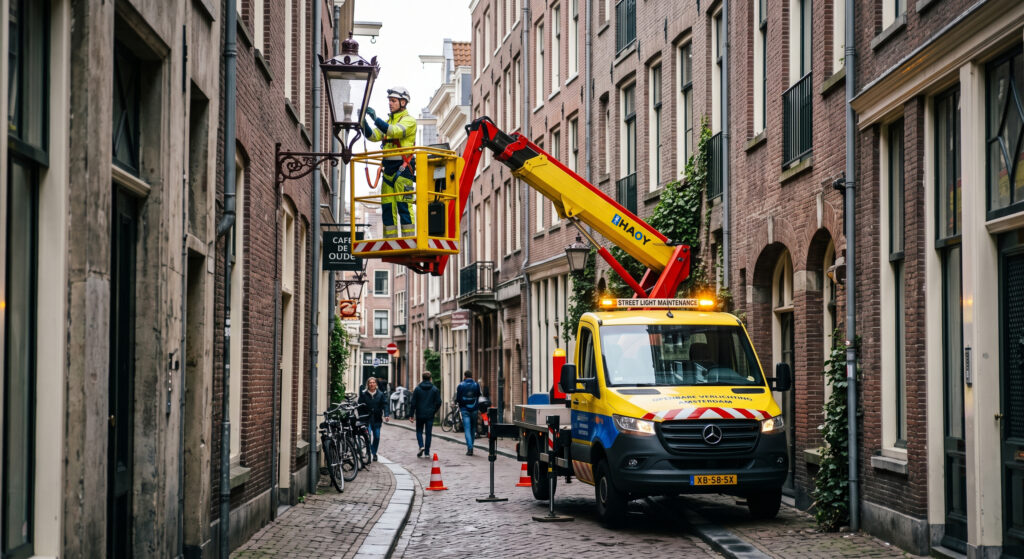
1. The Mechanics: Defining the Compact Articulated Truck Mounted MEWP
To evaluate this machinery asset from a procurement perspective, we must look beyond generic marketing terminology. A compact articulated truck mounted MEWP integrates a multi-jointed, folding boom structure onto a light or medium-duty commercial truck chassis (typically between 3.5-ton to 7.5-ton Gross Vehicle Weight).
Unlike straight telescopic cylinders that extend linearly, the articulated configuration utilizes a secondary master hinge (the knuckle joint). This geometric design allows the boom assembly to elevate vertically, bend over structural obstacles, and extend the fly-jib horizontally—all while utilizing a truck platform that retains the footprint of a standard commercial delivery van.
2. The Structural Physics: Why ‘Articulated & Compact’ Excels in City Centers
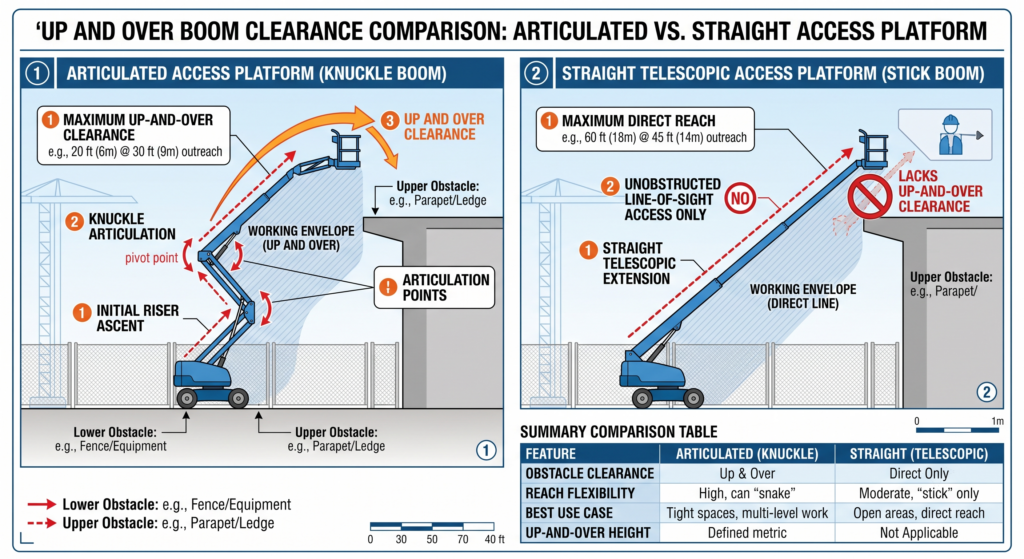
• 2.1 The Power of ‘Up-and-Over’ Overreach Capabilities
In municipal infrastructure work—such as urban street lighting maintenance, tree trimming, and historical building façade restoration—the target work zone is rarely unobstructed. Roadside trees, overhead power lines, shop canopies, and parked vehicles create continuous physical barriers. A straight-line telescopic truck crane or boom lift faces structural limitations here: it cannot bend. The articulated truck mounted MEWP solves this through superior up-and-over clearance. The lower boom lifts the articulation knuckle above the overhead lines, while the upper telescopic sections extend precisely into the workspace without moving the truck base.
• 2.2 Zero Tail Swing & Single-Lane Traffic Retention
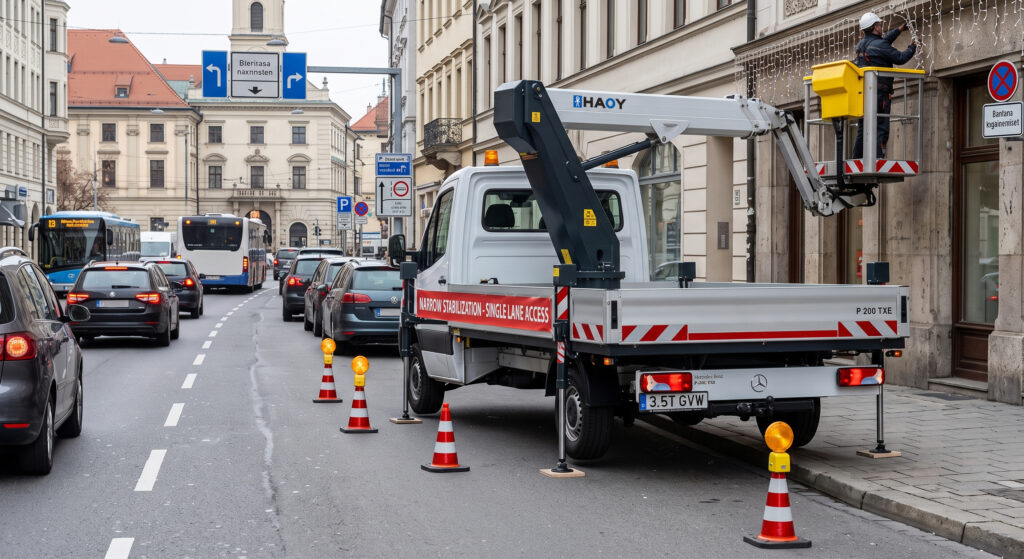
For highway maintenance contractors and traffic signal technicians, the cost of road closures is a massive drain on project margins. Deploying a traditional self-propelled boom lift or a heavy commercial truck crane often requires closing two to three traffic lanes due to the stabilizing outrigger spread and the rotating tail swing of the turret. Premium compact articulated MEWPs are specifically engineered with zero tail swing. When the turret rotates 360 degrees, the counterweight housing remains strictly within the width of the truck chassis mirror-line, allowing municipal traffic to flow uninterrupted in adjacent lanes.
3. The Financial Ledger: Driving Fleet Utilization and Lowering TCO
• 3.1 Navigating Gross Vehicle Weight (GVW) and Driver Licensing Barriers
One of the most significant hidden costs in fleet operations is operator and driver specialized licensing. Large, heavy-duty truck cranes and massive access platforms require specialized commercial driver’s licenses. Sourcing and retaining operators with these high-tier certifications significantly increases labor overhead. By optimizing the structural metallurgy and integrating compact articulated booms onto lightweight 3.5-ton chassis platforms, manufacturers offer high-altitude access that can be legally driven on standard passenger car driving licenses in many international markets.
• 3.2 Reducing Transit Downtime Between Work Sites
Self-propelled boom lifts require dedicated low-loader transport trucks to move them from one urban work site to the next. The logistics of loading, securing, transporting, and unloading these machines adds hours of non-productive transit downtime to every project. A truck-mounted MEWP is inherently mobile. It travels at highway speeds, passes smoothly through urban low-emission zones, and can move between distant jobs within minutes—completely eliminating independent transport freight bills and maximizing daily asset utilization rates.
4. Sourcing Checklist: Eliminating Integration Risks
If you are preparing an international Request for Proposal (RFP) for your company’s next fleet upgrade, ensure you audit direct-factory suppliers on the following technical touchpoints to prevent sub-standard vehicle integration:
1. Audit the PTO Torque and Gear Matching: Ensure the power take-off (PTO) system on the truck gearbox is perfectly matched to the hydraulic pump’s displacement. Incorrect matching causes rapid hydraulic oil degradation and sluggish basket response during high-precision micro-movements.
2. Verify the Stabilizer Interlock Logic: Demand fully integrated electronic outrigger sensor matrices. The system must automatically lock out boom operations if an outrigger loses ground contact pressure on uneven urban sidewalks or drainage slopes.
3. Confirm Dual-Inverter Power Options: For green-zone urban compliance, look for units fitted with dual-power packs—allowing the truck engine to drive the vehicle to the site, while an integrated plug-in electric-hydraulic pump powers the boom movements silently with zero emissions.
Conclusion
The question is no longer just how high your fleet can reach, but how cleanly and efficiently it can integrate into the delicate fabric of modern urban environments. The compact articulated truck mounted MEWP represents the lean evolution of mobile access platforms. By merging high-tensile ‘up-and-over’ structural physics with lightweight, highly mobile truck platforms, this equipment asset class solves the dual pressure of spatial restrictions and tightening operational budgets—making it an indispensable tool for forward-thinking B2B procurement managers worldwide.