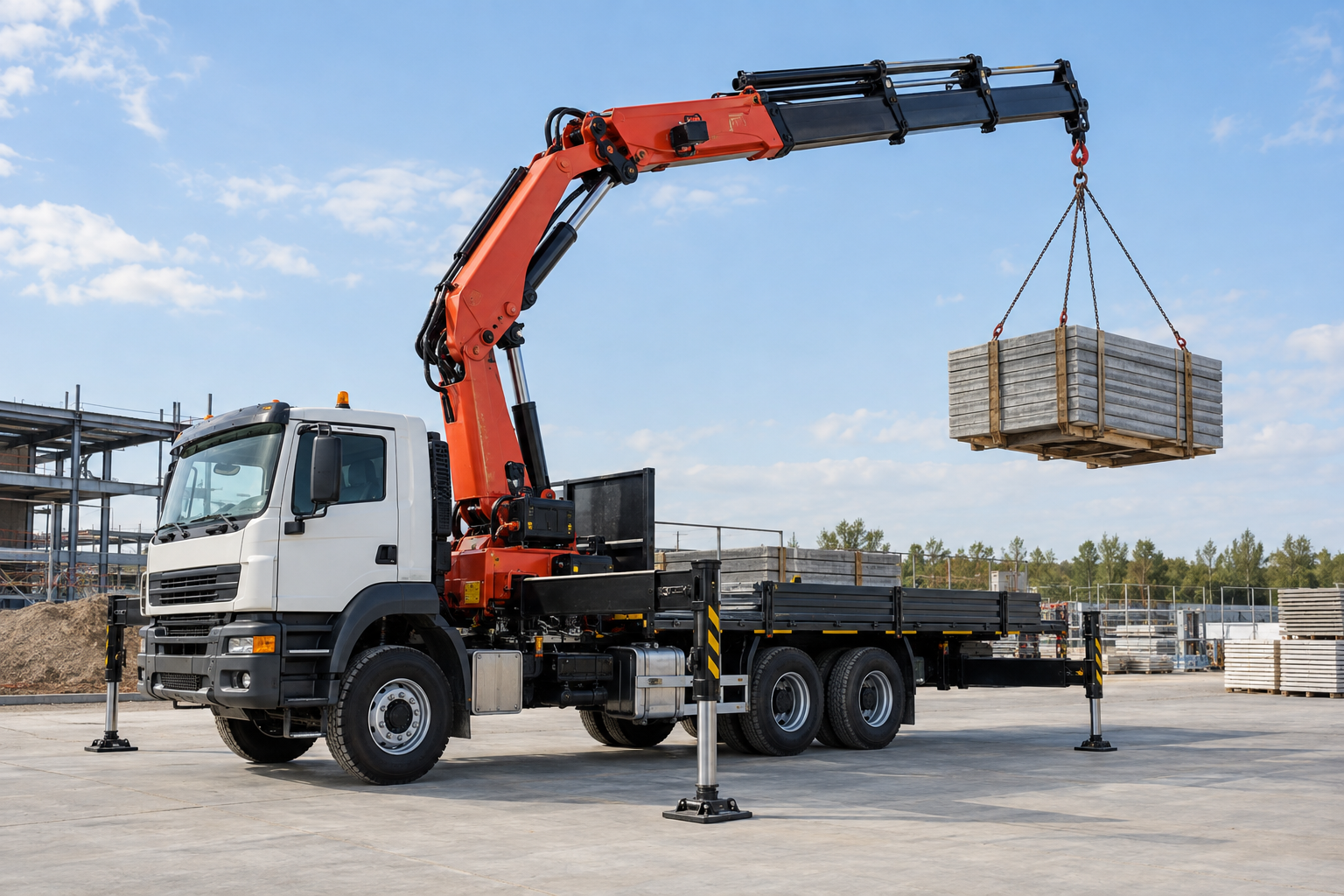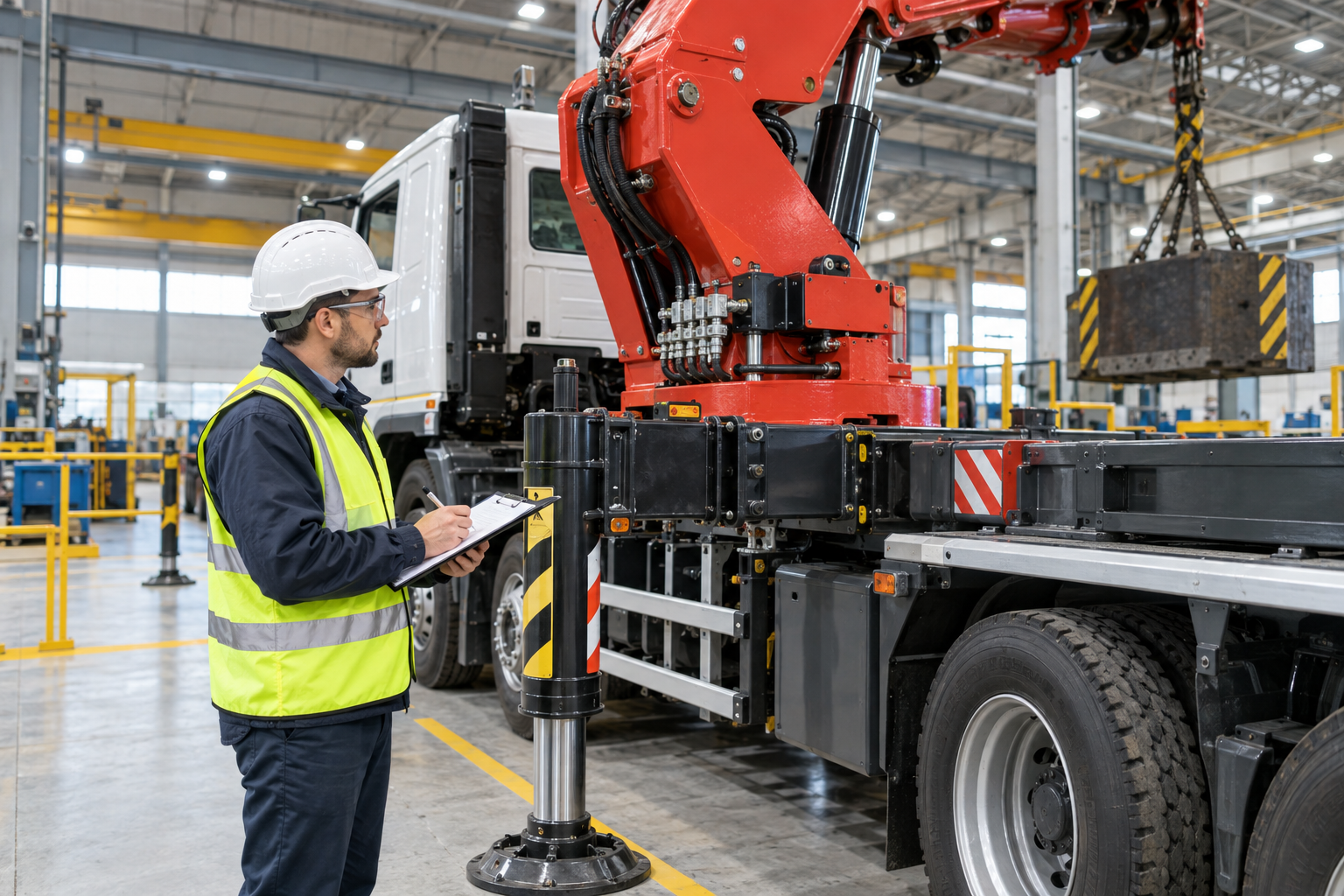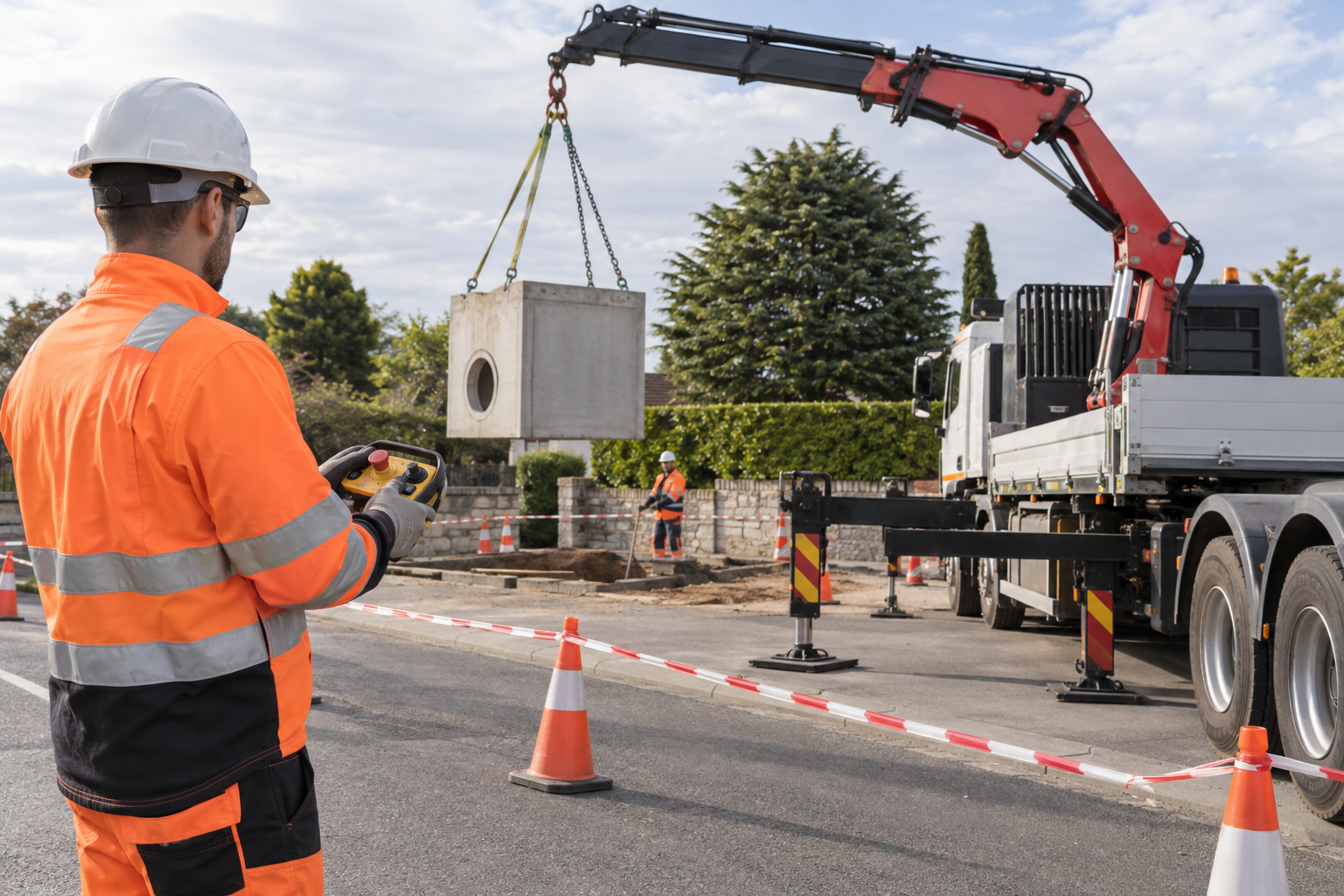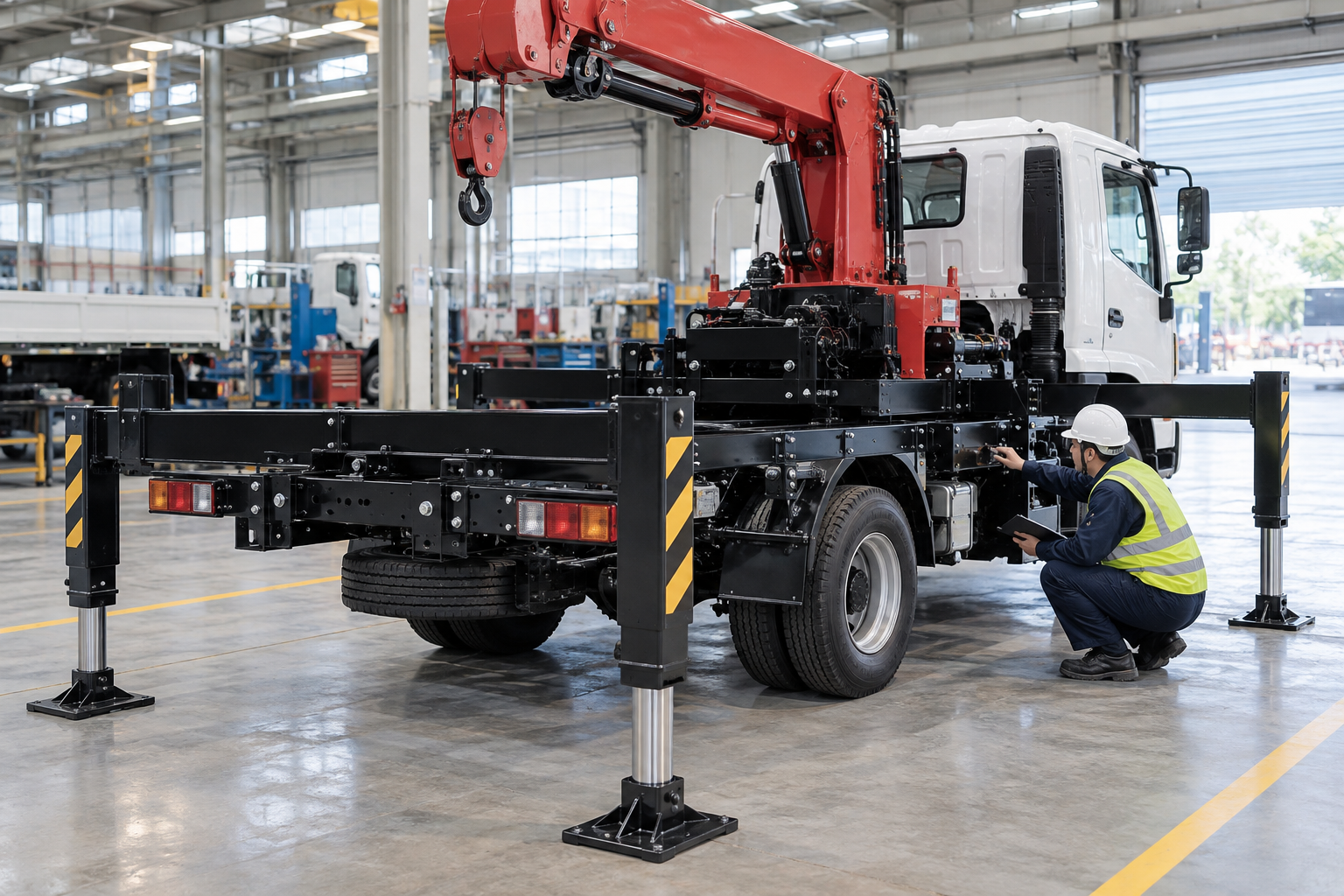
A truck mounted crane is designed to lift, move, and place heavy loads while mounted on a truck chassis. It combines the mobility of a commercial truck with the lifting ability of a hydraulic crane. Because it works in different environments such as construction sites, utility projects, logistics yards, municipal roads, farms, and roadside service areas, safety is one of the most important factors buyers should evaluate before purchasing.
The key safety features of a truck mounted crane usually include hydraulic outriggers, overload protection, load charts, hydraulic locks, emergency stop, wireless remote control, slewing protection, boom limit systems, stable sub-frame design, warning devices, and clear operation instructions. These features help reduce lifting risks, improve operator control, protect the truck chassis, and support safer lifting performance in real working conditions.
However, safety does not depend on one single device. A safe truck mounted crane requires a complete system: correct crane selection, proper chassis matching, reliable hydraulic components, strong structural design, professional installation, factory testing, and trained operation.
This article explains the major safety features buyers should check before sourcing a truck mounted crane and how these features affect daily operation.
1. Hydraulic Outriggers
Hydraulic outriggers are one of the most important safety features of a truck mounted crane. When the crane is lifting, the truck chassis alone cannot provide enough stability. Outriggers extend from the crane or truck frame to support the vehicle and reduce the risk of tipping.
A good outrigger system helps:
- Increase the supporting area
- Improve lifting stability
- Reduce chassis movement
- Balance the crane during operation
- Support lifting on uneven ground
- Improve safety when working at larger radius
For truck mounted cranes, outrigger design should match crane capacity, truck chassis, installation position, and working environment. A small crane may use a simple outrigger layout, while a larger crane may require stronger hydraulic outriggers and wider span.
| Outrigger Safety Check | Why It Matters |
|---|---|
| Outrigger span | Wider support usually improves stability |
| Hydraulic cylinder quality | Affects support strength and reliability |
| Outrigger beam structure | Affects long-term durability |
| Ground contact area | Helps distribute pressure |
| Operation method | Hydraulic operation is usually easier and safer |
| Installation position | Must match truck frame and crane base |
Outriggers should always be fully deployed according to the operation manual before lifting. If the ground is soft, operators should use proper outrigger pads to distribute pressure and prevent sinking.
2. Load Chart and Rated Capacity Information
A load chart is not only a technical document. It is also a safety tool. It tells the operator how much the crane can safely lift at different working radii.
One of the most common safety mistakes is assuming that a crane can lift its maximum rated capacity at any distance. For example, an 8-ton truck mounted crane does not mean it can lift 8 tons at every boom length or working radius. As the boom extends and the radius increases, the safe lifting capacity decreases.
A clear load chart helps users understand:
- Maximum lifting capacity
- Lifting capacity at different radii
- Maximum working radius
- Safe operating range
- Boom section limitations
- Correct crane selection for the job
Before buying a truck mounted crane, buyers should ask the supplier to provide or explain the load chart. Operators should also be trained to read the load chart before using the crane.
A professional supplier should not only say “this is an 8-ton crane.” The supplier should explain what the crane can actually lift at the required working radius.
3. Overload Protection System
An overload protection system helps prevent the crane from lifting loads beyond its safe working limit. Overloading can damage the boom, hydraulic cylinders, slewing system, truck chassis, and sub-frame. It can also cause tipping or sudden structural failure.
Depending on the crane model and configuration, overload protection may include:
- Load moment limiter
- Pressure protection
- Alarm system
- Automatic movement limitation
- Warning indicator
- Hydraulic safety valve
The purpose of overload protection is to remind or restrict the operator when the lifting condition becomes unsafe.
Buyers should confirm whether overload protection is included, optional, or required for their market. For some applications and countries, safety devices may be required by local regulations or project standards.
Even with overload protection, operators should not rely only on automatic systems. The correct load, working radius, ground condition, and outrigger setup must still be checked before lifting.
4. Hydraulic Lock and Holding Valves
Hydraulic locks and holding valves are important for preventing sudden movement of the boom, cylinder, or load. If there is a hydraulic hose failure, valve issue, or pressure loss, a proper hydraulic locking system can help reduce uncontrolled dropping or movement.
Hydraulic locks are commonly used in:
- Boom lifting cylinders
- Extension cylinders
- Outrigger cylinders
- Luffing cylinders
- Folding boom joints
These components help hold the boom or outrigger position during operation. For truck mounted cranes, this is especially important because the machine works with heavy loads and changing boom angles.
Buyers should pay attention to hydraulic system quality. Poor hydraulic components may cause oil leakage, unstable movement, slow response, or unsafe operation. A reliable crane should use suitable hydraulic valves, properly routed hoses, and tested cylinders.
5. Emergency Stop System
An emergency stop system allows the operator to stop crane movement quickly in dangerous situations. It is a basic but important safety feature.
Emergency stop may be installed on:
- Manual control station
- Remote control transmitter
- Electrical control box
- Operator platform
Emergency stop is useful when:
- A load moves unexpectedly
- A person enters the danger zone
- The crane movement becomes unstable
- The operator loses visibility
- There is hydraulic or electrical abnormality
- The crane approaches an obstacle
For cranes with wireless remote control, the emergency stop button on the remote control is especially important. It allows the operator to react quickly while standing in a safe and visible position.
Before each operation, the emergency stop function should be checked to ensure it works correctly.
6. Wireless Remote Control
Wireless remote control can improve both safety and efficiency for truck mounted crane operation. With manual control, the operator may need to stand close to the crane body, where visibility can be limited. With wireless remote control, the operator can move to a better position to observe the load, boom, truck, ground, and surrounding workers.
Wireless remote control helps:
- Improve operator visibility
- Reduce blind spots
- Keep the operator away from dangerous areas
- Improve communication during lifting
- Support precise load placement
- Reduce manual operation fatigue
This is especially useful in applications such as utility pole installation, streetlight maintenance, construction material handling, narrow road operation, equipment loading and unloading, municipal maintenance, farm lifting, and roadside service.
However, remote control quality matters. Buyers should check signal stability, emergency stop function, battery life, response speed, and operating distance. A remote control system should be tested before delivery and checked regularly during use.
7. Boom Limit and Slewing Protection
Boom limit and slewing protection systems help prevent the crane from moving beyond safe or designed operating ranges.
These systems may include:
- Boom angle limit
- Extension limit
- Slewing angle limit
- Mechanical stops
- Position sensors
- Warning alarms
- Movement restriction
Boom limit protection helps prevent the boom from being raised, lowered, extended, or folded into unsafe positions. Slewing protection can be useful when the crane is installed in a limited space or when the truck body, cab, cargo box, or nearby structure may interfere with crane rotation.
For customized truck mounted cranes, boom movement and slewing range should be considered during installation design. A crane installed behind the cab may have different movement limitations from a rear-mounted crane.
Buyers should confirm whether the crane layout allows safe movement in the intended working area.
8. Stable Crane Base and Sub-Frame Design
The crane base and sub-frame transfer lifting forces from the crane to the truck chassis. If the base or sub-frame is poorly designed, the crane may become unstable even if the crane itself is strong.
A proper base and sub-frame design helps:
- Distribute lifting force
- Protect the truck chassis
- Reduce frame deformation
- Improve crane stability
- Support outrigger installation
- Improve long-term durability
Chassis matching is very important. Before confirming a truck mounted crane order, buyers should provide truck chassis information, including wheelbase, frame width, frame thickness, axle capacity, available installation space, and PTO condition.
A reliable supplier should check whether the crane model is suitable for the truck chassis. If a supplier does not ask for chassis information, the buyer should be careful.
9. Anti-Slip Platform and Safe Access
Some truck mounted cranes have an operator platform, control station, inspection access, or maintenance area. These areas should be designed to reduce slipping, falling, or unsafe movement.
Safety design may include:
- Anti-slip step surface
- Guardrail where needed
- Safe control station location
- Clear access for maintenance
- Protected hydraulic pipelines
- Proper lighting for operation
- Warning labels
For vehicle-mounted equipment, operators often work outdoors in rain, dust, mud, or uneven jobsite conditions. Safe access design is important for reducing daily operation risks.
10. Warning Devices and Safety Labels
Warning devices and safety labels help remind operators and nearby workers about potential risks.
Common warning features include:
- Warning lights
- Buzzer alarms
- Operation labels
- Load warning marks
- Danger zone signs
- Hydraulic pressure warning
- Emergency stop labels
- Outrigger operation instructions
Clear labels are especially important for international buyers because operators, local service teams, and dealers may need to understand the crane’s safety requirements quickly.
Buyers should ask whether the supplier can provide labels, manuals, or operation instructions in the required language if needed.
11. Factory Testing Before Delivery
Safety features must be tested before delivery. A crane may look complete in photos, but real operation testing is necessary to confirm that the system works correctly.
| Test Item | What to Check |
|---|---|
| Boom movement test | Lifting, lowering, extending, folding |
| Slewing test | Rotation stability and control response |
| Outrigger test | Extension, retraction, and support function |
| Hydraulic leakage test | Hoses, cylinders, valves, fittings |
| Remote control test | Signal, buttons, emergency stop |
| Load test | Lifting performance under controlled conditions |
| Appearance inspection | Paint, labels, structure, welding |
| Packing inspection | Protection for export transportation |
Testing videos are useful for overseas buyers who cannot inspect the crane in person. Factory testing helps detect problems before shipping and reduces after-sales risks.
12. Operation Manual and Training Support
Even a well-designed truck mounted crane can be dangerous if operated incorrectly. Clear operation instructions are part of the safety system.
A good operation manual should include:
- Basic crane structure
- Control function explanation
- Load chart
- Outrigger operation
- Safe lifting procedure
- Daily inspection checklist
- Maintenance schedule
- Hydraulic system precautions
- Emergency stop use
- Troubleshooting guide
Training support may include videos, photos, remote guidance, or local dealer support. For first-time buyers, operation guidance is especially important.
Buyers should confirm what documents and support the supplier can provide before placing an order.
13. Daily Inspection Checklist
Safety does not end after delivery. Operators should inspect the crane regularly before use.
A simple daily checklist may include:
- Check hydraulic oil level
- Check for oil leakage
- Check boom structure
- Check hook and lifting accessories
- Check outriggers
- Check remote control battery
- Check emergency stop
- Check warning labels
- Check bolts and pins
- Check ground condition before lifting
- Check load weight and working radius
- Check surrounding obstacles
Daily inspection helps identify small problems before they become serious failures.
14. Safety Features Buyers Should Confirm Before Purchase
Before purchasing a truck mounted crane, buyers should confirm the following safety-related items:
| Safety Item | Buyer Question |
|---|---|
| Load chart | Can you provide the lifting capacity at different radii? |
| Outriggers | What outrigger type and span are recommended? |
| Overload protection | Is overload protection included or optional? |
| Hydraulic locks | Are holding valves used in key cylinders? |
| Emergency stop | Where is the emergency stop installed? |
| Remote control | Does the remote control include emergency stop? |
| Chassis matching | What truck chassis information do you need? |
| Factory test | Can you provide load test video before delivery? |
| Manual | Can you provide operation and maintenance instructions? |
| Spare parts | What safety-related spare parts are recommended? |
These questions help buyers compare suppliers beyond price.
15. How HAOY Supports Safer Truck Mounted Crane Solutions
For buyers sourcing customized truck mounted cranes, safety should be considered from the beginning of the project. HAOY supports application-based crane selection by discussing lifting capacity, working radius, truck chassis information, control method, outrigger configuration, and working environment before confirming the final model.
The company provides truck mounted cranes, knuckle boom cranes, telescopic boom cranes, mini truck cranes, marine cranes, and vehicle-mounted aerial work vehicles. For customized lifting equipment, HAOY can support OEM/ODM requirements and accept orders from one unit, which is useful for buyers who need one crane for one project, one truck chassis, or one sample order.
For safety-related configuration, buyers can discuss hydraulic outriggers, wireless remote control, boom type, working radius, load testing, and application-specific requirements before production. This helps reduce the risk of choosing a crane that does not match the real working condition.
FAQ About Truck Mounted Crane Safety Features
What is the most important safety feature of a truck mounted crane?
Hydraulic outriggers and the load chart are among the most important safety features. Outriggers improve stability, while the load chart helps operators understand safe lifting limits at different working radii.
Why are outriggers important for truck mounted cranes?
Outriggers increase the support area and help stabilize the truck during lifting. Without proper outrigger support, the crane may become unstable or unsafe.
Does an 8-ton truck mounted crane lift 8 tons at every radius?
No. The maximum rated capacity usually applies only at a short working radius. As the boom extends and the working radius increases, safe lifting capacity decreases.
Is wireless remote control safer than manual control?
Wireless remote control can improve safety because the operator can stand in a position with better visibility and stay away from dangerous areas. However, the system must be reliable and properly tested.
What should buyers check before using a truck mounted crane?
Buyers and operators should check the load weight, working radius, ground condition, outrigger deployment, hydraulic system, emergency stop, hook, boom structure, and surrounding obstacles before lifting.
Can a truck mounted crane be installed on any truck chassis?
No. The truck chassis must be checked for frame strength, wheelbase, axle load, installation space, PTO compatibility, and sub-frame requirements.
Why is factory testing important before delivery?
Factory testing helps confirm boom movement, outrigger function, hydraulic performance, remote control response, emergency stop, and load lifting ability before shipment.
Conclusion
The key safety features of a truck mounted crane include hydraulic outriggers, load charts, overload protection, hydraulic locks, emergency stop systems, wireless remote control, boom limit protection, stable base design, warning devices, factory testing, and clear operation instructions.
For buyers, safety should not be evaluated only by checking one device or one parameter. A safe truck mounted crane must match the actual lifting task, truck chassis, working radius, ground condition, operator method, and application environment.
Before buying, buyers should ask suppliers for load charts, chassis matching advice, outrigger configuration, hydraulic system details, factory testing videos, operation manuals, and after-sales support. These steps help reduce risks and improve long-term equipment reliability.
HAOY can support customized truck mounted crane solutions for buyers who need equipment matched to real project conditions. By confirming lifting requirements, chassis information, working radius, and safety configuration before production, buyers can choose a truck mounted crane that is safer, more practical, and better suited to daily operation.