
Rear-Mounted vs Behind-Cab Truck Cranes: The Short Answer
A behind-cab truck crane is installed immediately behind the driver’s cab, while a rear-mounted truck crane is installed close to the back of the chassis. Neither location is automatically safer or more efficient. The better choice depends on the pickup and placement points, axle limits, body length, stabilizer arrangement, chassis structure, and rated lifting capacity in each operating sector.
Behind-cab mounting is often selected for general material delivery and loading beside the vehicle. Rear mounting may be useful when work is concentrated behind the truck, such as placing materials at the end of a driveway or near a building entrance. Both arrangements require an approved installation design, suitable chassis reinforcement, and a stability assessment for the finished vehicle configuration.
For international buyers, the right question is not simply “rear or behind the cab?” It is “which mounting location can perform my most demanding lift safely without compromising the truck’s legal and practical carrying capacity?”
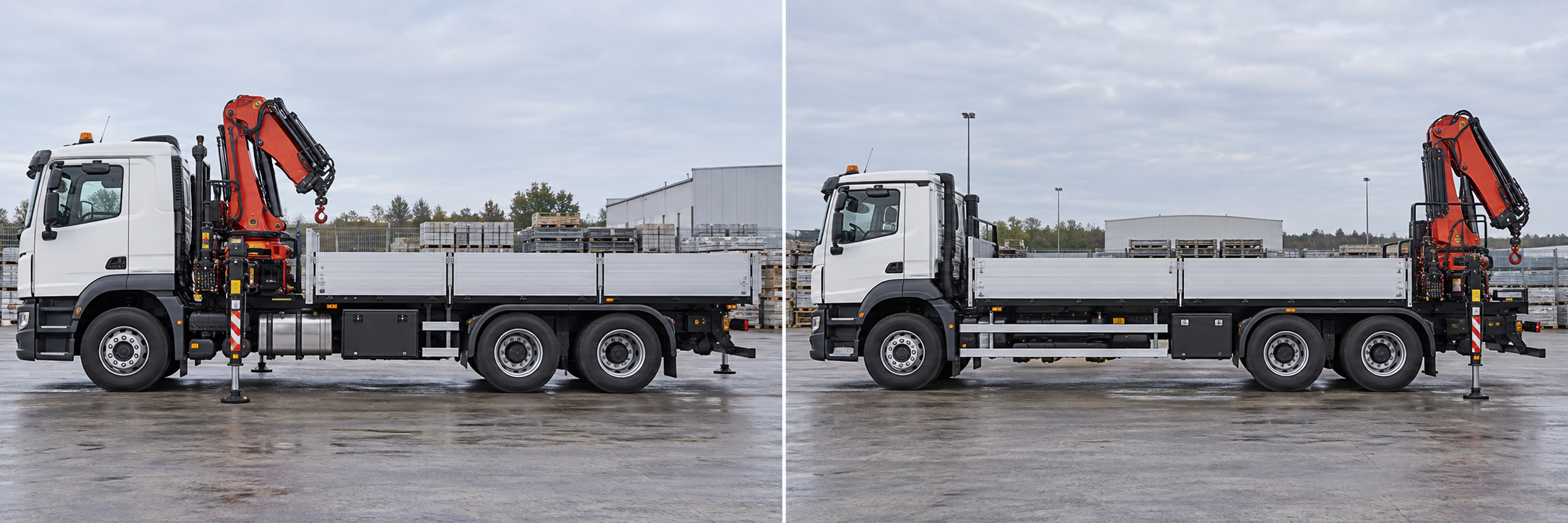
What Is a Behind-Cab Truck Mounted Crane?
A behind-cab crane sits between the cab and the cargo body. It is familiar on building-material delivery trucks, utility vehicles, and many knuckle boom trucks. The crane can reach the ground beside the truck and, with a suitable design, load or unload the body. Because it occupies space immediately behind the cab, the remaining usable body length must be planned carefully.
The position can simplify certain hydraulic and control layouts, although compatibility with the truck PTO, frame, exhaust system, and cab clearance still needs engineering review. A short-wheelbase truck or a chassis with limited payload reserve may not be a good candidate for this configuration.
What Is a Rear-Mounted Truck Crane?
A rear-mounted crane is installed near the rear of the chassis, often behind the cargo body. It can be useful when the main lifting task takes place behind the vehicle, or when operators need to serve a work area without frequently repositioning the truck. Depending on the crane and body layout, rear mounting may preserve a continuous loading area closer to the cab.
However, concentrated weight at the back can increase rear-axle loading and alter handling when the truck is traveling. Rear overhang, frame strength, tail swing, and stabilizer location are critical. The location should never be selected only because it appears to create more cargo space.
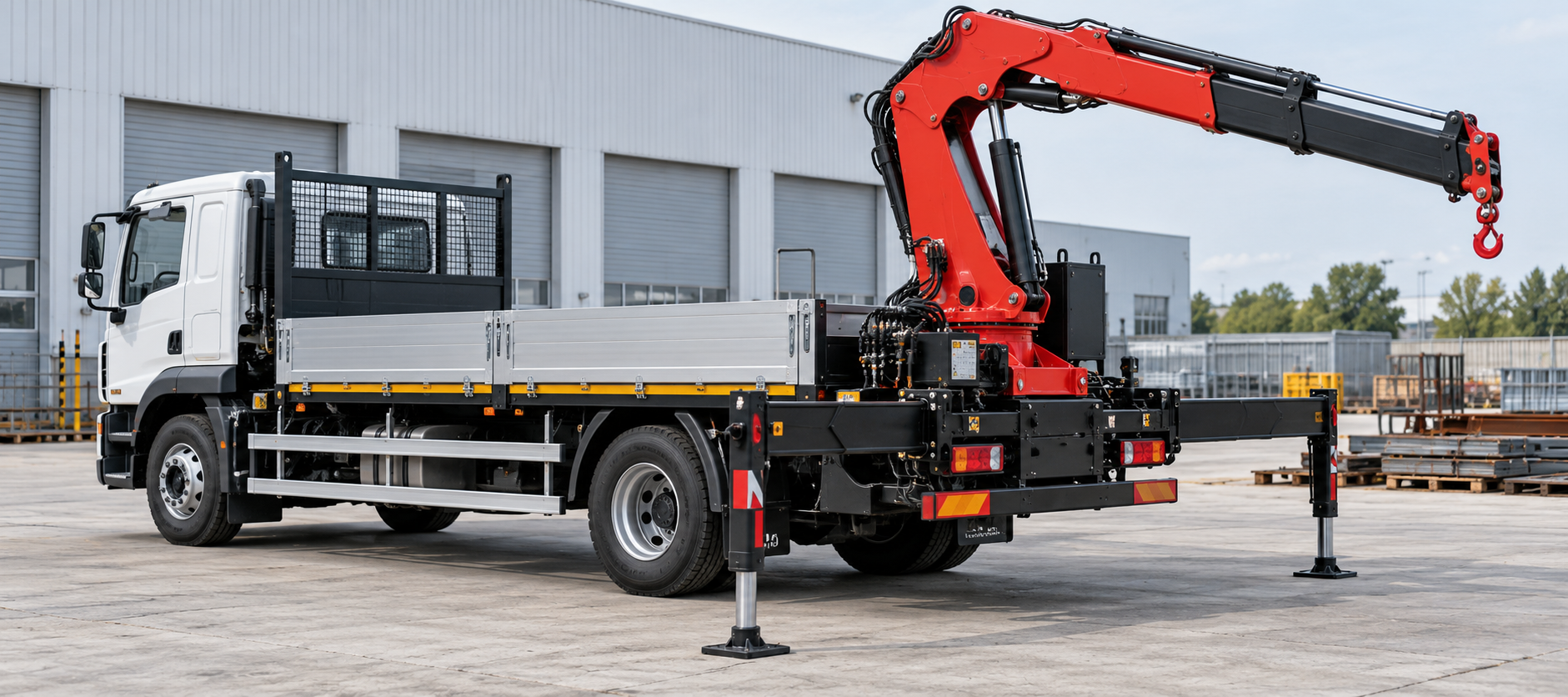
Rear-Mounted vs Behind-Cab: Main Differences
The comparison below describes common design considerations, not a universal performance ranking. Manufacturer load charts and vehicle-specific calculations should decide the final arrangement.
| Decision factor | Behind-cab mounting | Rear mounting |
|---|---|---|
| Typical lift access | Common for loading beside the truck and onto the body | Often convenient for work behind the truck |
| Cargo-body planning | Uses space between cab and body | Moves the installation envelope toward the rear |
| Axle-load impact | Changes front/rear distribution according to layout | Can concentrate more mass toward the rear axle |
| Rear overhang | Usually less affected by crane location | Requires careful overhang and transport checks |
| Stabilizer design | Must suit the crane, chassis, and body | Must suit rear-mounted load cases and sectors |
| Best choice | Depends on the actual pickup and placement points | |
How Does Mounting Position Affect Stability?
Crane stability depends on the combined vehicle and lifting system, not only on the position of the crane. Load weight, working radius, slewing direction, stabilizer spread, supporting ground, chassis stiffness, and additional vehicle payload all influence the available stability margin.
A rear-mounted crane may have different lifting limits when working over the rear, the side, or across the body. The same is true for a behind-cab crane. Some cranes have different permitted loads in different rotation sectors, especially when stabilizers are only partially extended. Buyers should ask for the rated capacity and any restrictions for the planned mounting configuration.
The crane should never be assessed by lifting moment alone: truck rollover resistance and structural strength are separate checks. A crane strong enough to lift a load may still be unsuitable for a particular chassis or stabilizer arrangement.
What Happens to Axle Loads and Legal Payload?
Axle loading is one of the most overlooked purchasing issues. A crane adds permanent mass to the truck, together with its mounting frame, hydraulic tank, stabilizers, tools, and accessories. Its location also changes how this mass is distributed between the axles.
Rear mounting can increase rear-axle loading and may reduce front-axle loading on some layouts. Behind-cab mounting also changes the distribution, but its exact effect depends on the position relative to the axles and the remaining cargo body. Neither approach guarantees a higher legal payload.
Before ordering, request a weight-distribution calculation for the proposed finished vehicle, including anticipated cargo. Check gross vehicle weight, individual axle ratings, wheelbase, rear overhang, and local regulations. Transport stability must be evaluated separately from crane stability during lifting.
Which Mounting Position Provides Better Working Reach?
Reach is not just the maximum boom length stated in a brochure. The useful working envelope depends on where the crane is mounted and where the vehicle can park. If the unloading point is behind the vehicle, a rear-mounted crane might offer a more convenient route to the load. If the truck frequently unloads onto both sides of the body, a behind-cab unit may be practical.
Buyers should mark pickup and drop-off points on a simple site sketch. Include obstacles, overhead lines, parking constraints, and the direction of slewing. The supplier can then compare usable reach and capacity at those points rather than quoting a maximum reach that may not be achievable with the actual load.
For a broader pre-order checklist, see what information is needed before requesting a truck mounted crane quote.
Cargo Space, Body Length, and Everyday Use
A behind-cab crane occupies longitudinal chassis space that might otherwise be used for a cargo body. This matters for logistics companies transporting long or bulky materials. A rear-mounted crane moves that installation envelope toward the back, but it may create new limits on tail clearance, body loading, rear access, legal overall length, and rear axle loading.
For a delivery truck, consider both how many materials it can legally carry and how easily they can be unloaded. For a service vehicle, consider tool compartments, access steps, traffic-management equipment, and whether the crane must operate with the body loaded.
Outriggers and Subframe Requirements
Both configurations need an engineered method of transferring crane loads into the chassis. The mounting base and subframe must be designed for the selected crane, chassis manufacturer requirements, and intended loading conditions. The stabilizer footprint must also work where the truck will operate.
Important questions include whether stabilizers can extend fully in narrow streets, whether weak ground prevents adequate support, and whether a separate rear stabilizer arrangement is required. Restricted-outrigger operation must follow manufacturer-approved charts and protection systems.
For safety and testing context, review the key safety features of a truck mounted crane and what buyers should check in a truck mounted crane load test.
Which Installation Is Better for Different Applications?
These are starting points for a technical discussion, not final design recommendations. The actual load chart and installation assessment may lead to a different answer.
| Application | Often worth evaluating | Reason to check |
|---|---|---|
| Building-material delivery | Behind-cab | Side loading and access to the cargo body |
| Utility and pole work | Either arrangement | Parking position and safe working envelope |
| Material placement behind truck | Rear-mounted | Convenient access behind the vehicle |
| Municipal work in narrow streets | Either arrangement | Outrigger width, obstructions, and allowed sectors |
| Long cargo transportation | Compare both | Body length, axle loading, and overall dimensions |
| General rental or mixed jobs | Either arrangement | Versatility across the real job mix |
Common Mistakes Buyers Should Avoid
- Choosing the mounting position from photos rather than a dimensioned vehicle drawing.
- Comparing crane tonnage without checking load at the required working radius.
- Ignoring transport axle loads after the crane, subframe, and cargo are included.
- Assuming a rear-mounted crane automatically has better stability or reach.
- Using a standard stabilizer layout without checking the real lifting sectors.
- Failing to confirm cab, body, tire, suspension, hydraulic, and exhaust clearances.
- Ordering before verifying local vehicle registration and installation requirements.
What Should Buyers Send Before Requesting a Quote?
A useful inquiry gives the manufacturer enough detail to check the intended configuration. Include the truck brand and model, wheelbase, axle ratings, frame dimensions, available mounting space, planned cargo-body dimensions, expected payload, PTO details, and the intended installation position.
Also describe the heaviest load, required horizontal radius and lifting height, and the direction in which the crane will normally operate. Photos and a basic site drawing help when work takes place near buildings, roadside obstacles, trees, or narrow roads.
How HAOY Supports Customized Crane Mounting Solutions
HAOY, the brand associated with Xuzhou Haoyi Engineering Machinery Technology Co., Ltd., offers knuckle boom and telescopic boom truck mounted cranes and supports OEM/ODM customization. For suitable complete-equipment projects, customized orders can start from one unit. Customers can discuss crane size, boom configuration, control method, mounting position, and stabilizer requirements based on intended use.
For either rear-mounted or behind-cab installation, final suitability should be established through chassis information, crane load charts, engineering review, and applicable local requirements. Buyers should ask for the relevant installation dimensions and confirmation of the agreed equipment configuration before production.
Frequently Asked Questions
Is a rear-mounted crane safer than a behind-cab crane?
Not necessarily. Safety depends on capacity at the actual radius, stabilizer setup, chassis and subframe design, axle loading, lifting direction, ground conditions, and correct operation. Both positions can be appropriate when properly engineered.
Does a rear-mounted crane have a longer working radius?
The crane’s rated reach does not automatically change because it is mounted at the rear. What changes is its position relative to the pickup and drop-off points, so effective reach for a particular task may improve or worsen.
Can I move my existing behind-cab crane to the rear of the truck?
A relocation is not a simple bolt-on change. The subframe, stabilizers, hydraulic piping, load charts, frame loads, weight distribution, and legal compliance would all need to be reassessed. Consult the crane and chassis manufacturers and a qualified installer.
Which position is better for a knuckle boom crane?
Both can work. Knuckle boom cranes are valued for compact folding and flexible handling, but the preferred mounting point depends on the vehicle layout and tasks. Do not select it solely by crane type.
Does mounting position change the truck’s payload capacity?
It can. Permanent equipment mass and its position affect gross vehicle weight, axle loads, usable body dimensions, and permissible cargo distribution. Request a completed-vehicle weight calculation.
What information does a manufacturer need to compare both options?
Provide chassis drawings or dimensions, axle ratings, wheelbase, planned cargo body, crane load and radius, working directions, stabilizer space, PTO information, and destination-country requirements.
Conclusion: Choose by the Working Envelope, Not by Appearance
Behind-cab and rear-mounted truck cranes solve different layout problems. Behind-cab mounting often works well for general material handling around the truck body. Rear mounting may be attractive when loads are mainly handled behind the vehicle. Neither choice is universally superior in stability, lifting capacity, or payload.
Before placing an order, compare the required lifting tasks with a vehicle-specific installation plan, approved crane load charts, axle-load calculations, and stabilizer arrangements. That approach is more reliable than selecting a mounting position from a product photograph or maximum crane capacity alone.
For a project review, send the truck model, chassis dimensions, anticipated payload, heaviest lifting task, working radius, and preferred installation position. A technically sound recommendation starts with those details.