
The right truck mounted crane for utility pole installation is not simply the machine with the highest advertised lifting capacity. It is the crane that can safely handle the actual pole weight at the required working radius, on a suitable truck chassis, with enough support and control for the jobsite. Buyers should check the manufacturer’s load chart, pole dimensions, lifting height, road access, outrigger space and local utility-work rules before selecting a model.
A pole-setting crew may work beside a narrow rural road one day and near buildings or overhead lines the next. The lifting equipment needs to reach the position where the pole will be placed without forcing the operator to overload the boom or move the truck into an unsafe location. That is why application details are more useful than asking for a “5-ton” or “8-ton” crane alone.
This guide explains how to evaluate truck mounted cranes for utility pole handling, where knuckle boom and telescopic boom designs differ, and what information to send a manufacturer before requesting a quotation.
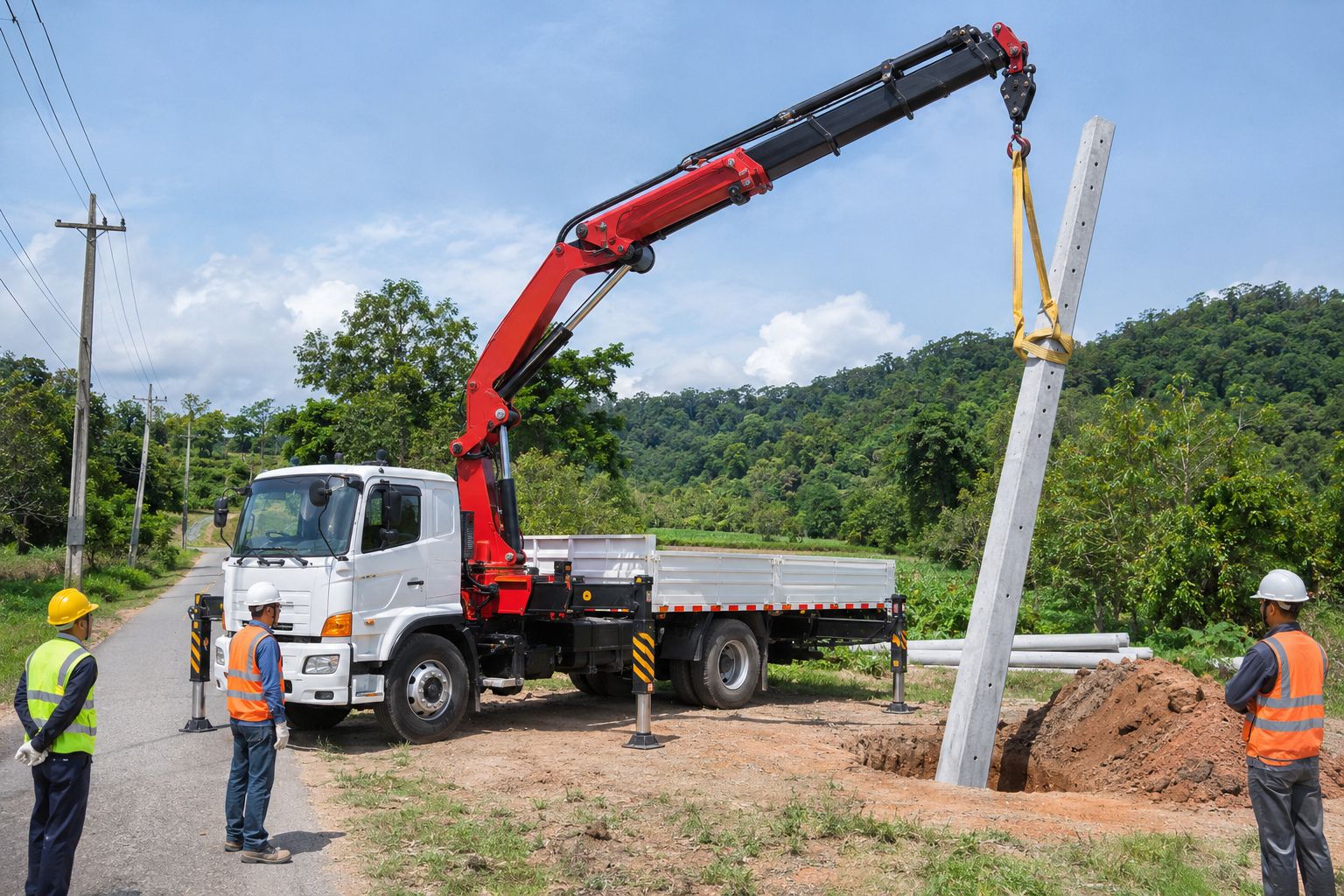
1. Start with the Pole, Not the Crane Model
Before selecting equipment, record what the crew will actually lift. Concrete, steel, timber and composite poles can differ substantially in weight distribution, length, surface condition and approved lifting points. A pole that appears manageable on the ground may be difficult to position when it is suspended near an excavation.
Ask the installation team for the pole’s confirmed weight and length, the location of its center of gravity, the approved rigging method, and the final setting position. Include the mass of the slings, lifting beam, clamp or other attachments when determining the total suspended load. If the pole will be handled with attached hardware, include that weight as well.
Do not estimate pole weight from its height alone. Obtain it from the pole supplier’s documentation or another verified source. Where the center of gravity or lifting points are unclear, have a qualified person establish the rigging plan.
2. Check the Real Working Radius and Load Chart
Working radius is the horizontal distance from the crane’s rotation center to the vertical line through the load. It often changes during the lift. A pole may be picked from the truck bed, swung toward the hole and then raised into position; each phase can create a different load radius and boom configuration.
The crane’s rated maximum capacity normally describes a particular short-radius condition. It does not mean the crane can lift that weight at full extension. Buyers should compare the total suspended load with the rated capacity at the most demanding radius and boom position, using the exact manufacturer’s load chart and the specified outrigger configuration.
For example, if a pole and all rigging together weigh 900 kg, and the farthest required radius is 7 m, the first check is whether the selected crane’s approved chart permits that load at 7 m in the planned setup. The simple product of load and radius is not a substitute for a load chart: boom self-weight, geometry, stability, structural limits and other design factors also matter.
A useful supplier question is: “What is the permitted lifting capacity at my actual radius, with the specified outrigger spread?” This is much more informative than asking only for the crane’s nominal tonnage.
3. Choose Between Knuckle Boom and Telescopic Boom
Both crane types can be useful for pole work, but their movement and storage characteristics are different.
| Decision factor | Knuckle boom truck crane | Telescopic boom truck crane |
|---|---|---|
| Boom arrangement | Articulated sections fold at joints | Straight boom extends in line |
| Truck storage | Typically compact when folded | Requires space for the stowed straight boom |
| Positioning around obstacles | Articulated geometry can be helpful | Straight reach may simplify some lifting paths |
| Typical consideration | Restricted access and flexible load positioning | Reach, lifting height and straightforward boom geometry |
| What still needs checking | Exact load chart and clearances | Exact load chart and clearances |
A knuckle boom can be helpful when equipment must work around trees, structures or limited access, although its articulation does not remove clearance hazards. A telescopic crane may be better suited to an open work area requiring a long, direct lifting path. Neither design is automatically safer or stronger. Compare actual load charts, working envelope, truck packaging and the crew’s operating method.
For repetitive utility-pole installation, a purpose-built digger derrick or pole-setting truck may also deserve consideration. A conventional truck mounted crane can lift a pole, but it is not automatically a substitute for equipment designed to drill holes and set poles. Any auger, pole clamp or other attachment requires manufacturer-approved compatibility and a specific safe-use plan.
4. Make Sure the Truck Chassis Can Carry the System
The crane is only one part of the lifting vehicle. The chassis, mounting frame and axle loading must be checked as a complete system. A crane that fits physically behind the cab may still place excessive loads on an axle or leave insufficient legal payload for poles and tools. See How Much Does It Cost to Install a Truck Mounted Crane? for related installation considerations.
For a practical chassis review, provide the truck make and model, gross vehicle weight rating, axle ratings, wheelbase, frame dimensions, body layout and available mounting space. Also confirm power take-off compatibility or another approved hydraulic power source. The crane supplier and qualified vehicle installer should evaluate the subframe, fasteners, mounting location and resulting weight distribution.
If the truck will travel on public roads, confirm local registration, dimension and axle-load requirements. A technically workable installation is not necessarily road-legal in every destination market.
5. Evaluate Outriggers and Ground Conditions
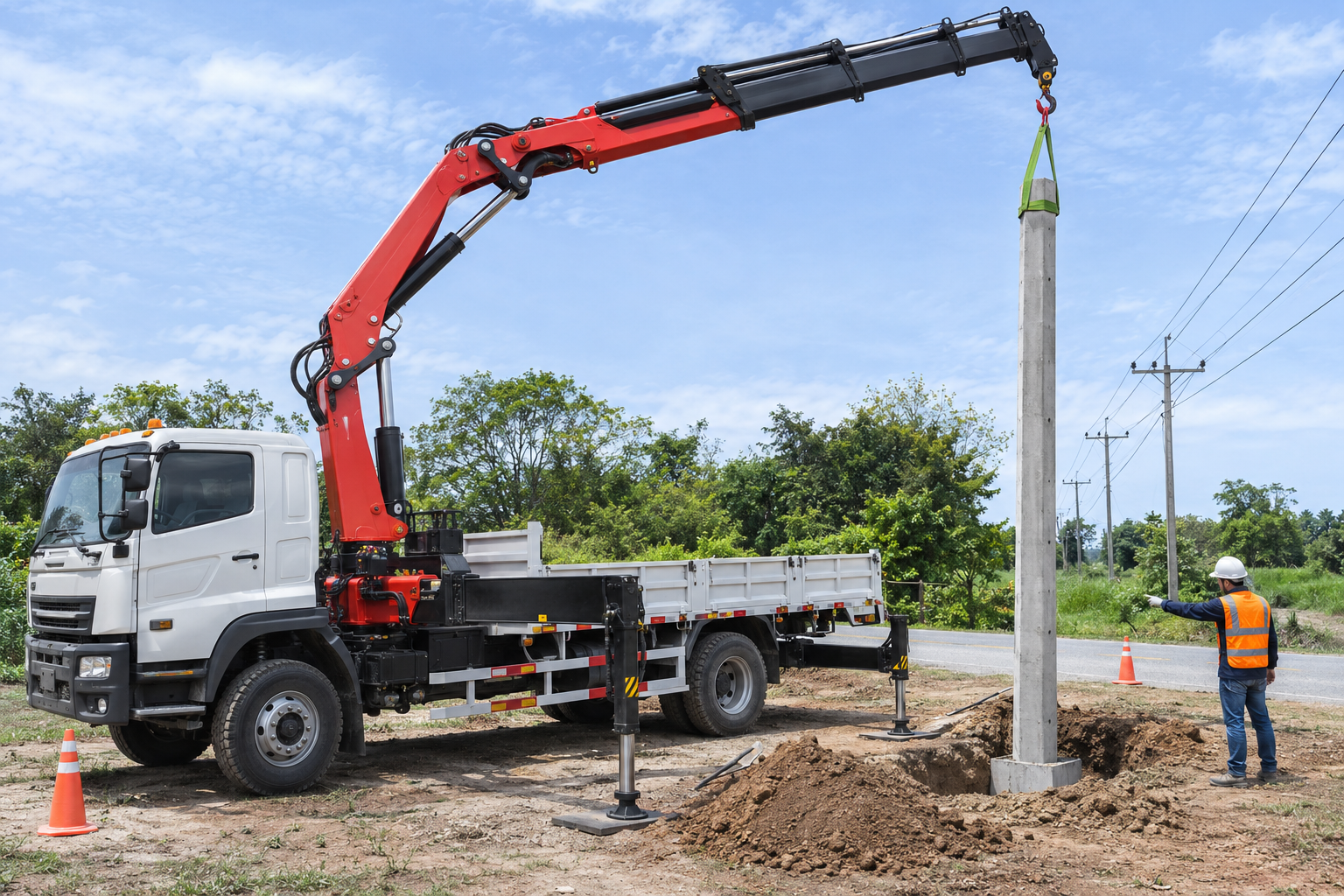
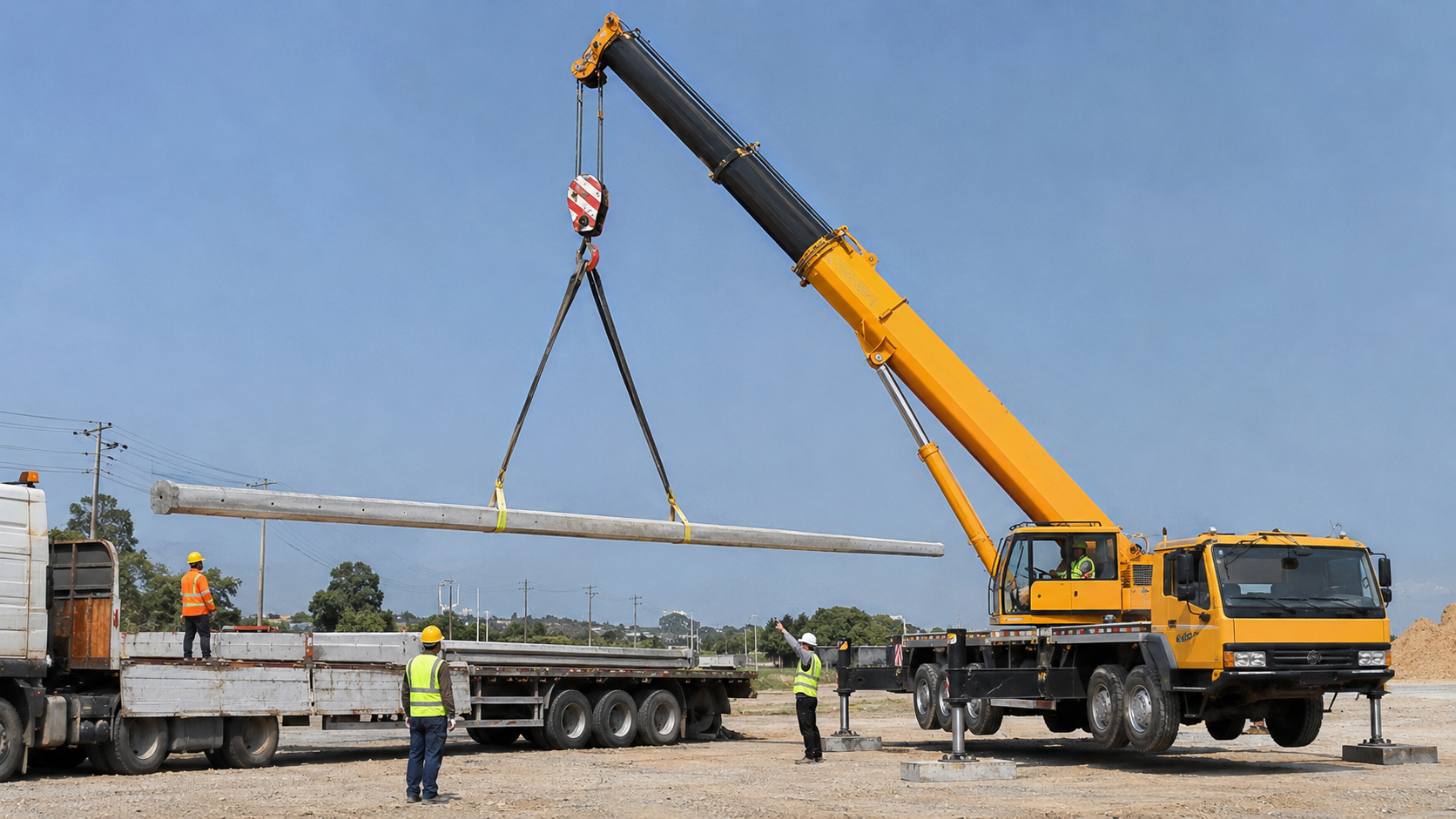
Utility crews frequently work on road shoulders, gravel, compacted soil or recently disturbed ground. These surfaces can look firm while lacking adequate bearing strength under an outrigger foot. Stability therefore depends on both the crane configuration and the ground supporting it.
Check the outrigger spread required by the load chart, available deployment space, slope limits, nearby trenches, buried utilities and the need for engineered outrigger pads or mats. Do not assume a narrow shoulder is safe merely because the truck’s tires are on pavement. The support system may extend beyond the road edge onto weaker ground.
Before lifting, the operator should use the prescribed outrigger setup and confirm that the supporting surface is adequate. Any restriction on outrigger extension must be accounted for in the approved rating; do not use a full-spread load chart for an unapproved partial-spread condition.
6. Treat Overhead Electrical Hazards as a Separate Planning Decision
Pole-setting work often takes place close to energized conductors and existing electrical infrastructure. This is one of the most serious differences between ordinary material handling and utility construction.
The crew must identify energized lines and other electrical hazards before positioning the truck or crane. Work planning should prioritize de-energizing and verifying the safe condition where required, establishing exclusion zones, and following the minimum approach distances and procedures applicable to the job’s jurisdiction, voltage and crew qualifications. Do not assume a wireless remote control makes work near power lines safe. The boom, load, pole, rigging and truck may all create an electrical contact hazard.
Only qualified personnel should plan and perform utility work where electrical exposure exists. The crane manufacturer’s instructions, site safety plan and applicable utility rules take precedence over general buying advice. An article or product catalogue cannot determine a safe clearance distance for a specific energized installation.
7. Pay Attention to Rigging and Pole Control
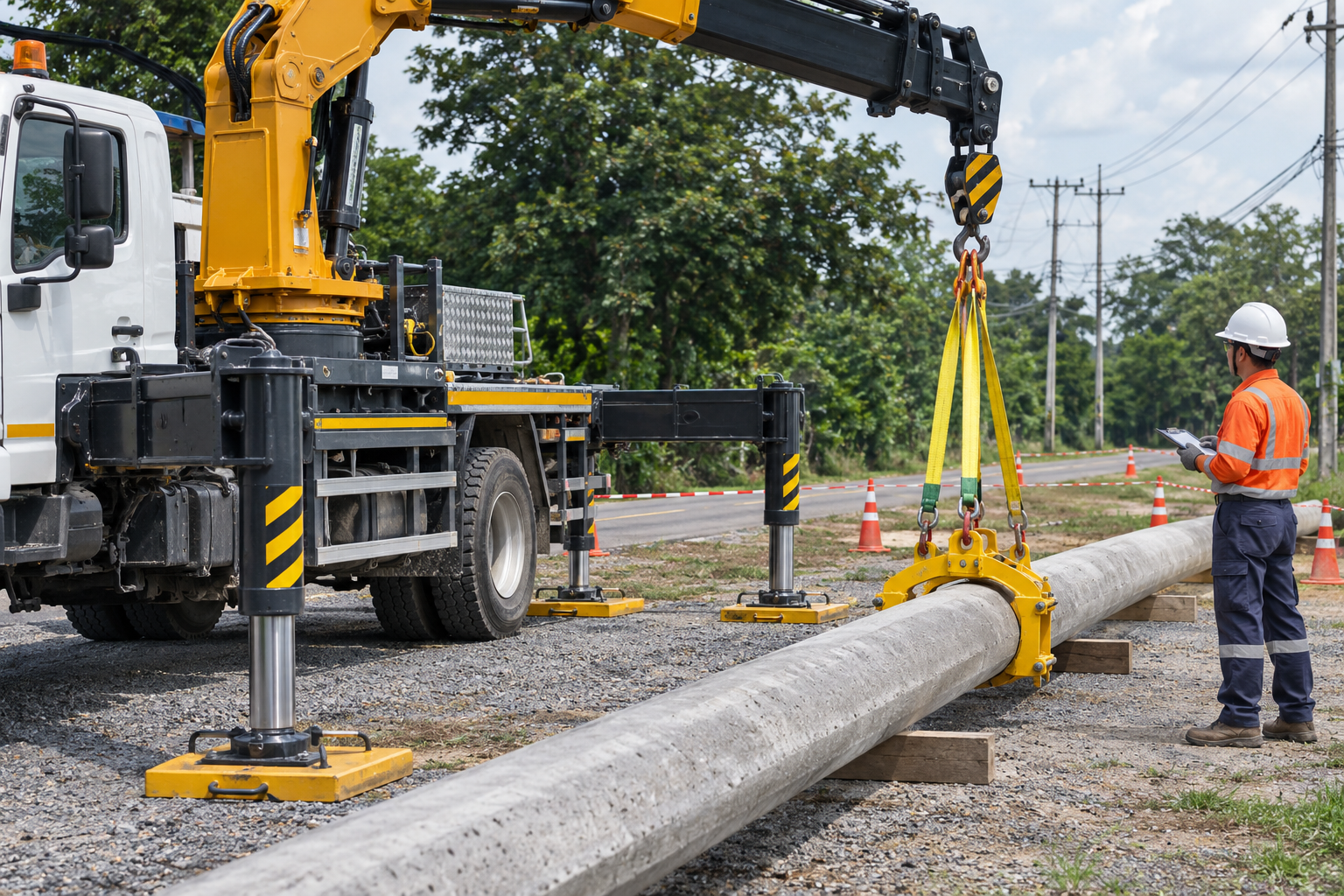
A pole is a long load with a changing orientation. It can rotate, swing or strike nearby objects when lifted, particularly in wind. Correct rigging matters as much as lifting capacity.
The lifting plan should identify approved attachment points, suitable rated lifting gear, load balance, and how the pole will be guided without putting workers beneath the suspended load. Tag lines may be useful when the lifting plan permits them, but crew members must remain outside pinch points and other danger zones. Side pulling, dragging a pole with the boom, or using the crane to force the pole into a hole can introduce loads the equipment was not designed to carry.
When the pole is being set into a foundation or excavation, coordinate crane movement with the ground crew and define clear communication signals. Stop when the load path becomes obstructed or the operator loses control of the lift.
8. Decide Which Controls and Safety Functions Are Needed
Wireless remote control can improve operator sight lines, particularly when the driver-side control station does not provide a view of the foundation or unloading area. It may allow the operator to move to a more suitable location while staying outside the danger zone. However, control-system quality and crew procedures remain essential.
Ask whether the specific crane configuration includes appropriate load-limiting functions, emergency stop, holding or counterbalance valves, warning indicators and control protections. Features differ by model and destination requirements; they should not be assumed from the product name. Confirm whether manual controls are also available and how the machine behaves following power or signal loss. Review What Are the Key Safety Features of a Truck Mounted Crane? for a related safety checklist.
A buyer should request operating instructions and an explanation of the safety devices actually included in the quoted configuration, rather than relying on generic promotional descriptions.
9. Compare the Whole Installation Workflow
When two cranes appear similar on paper, compare how each would complete the actual job. Can the truck access the pole location without blocking an unsafe area? Can the outriggers extend fully? Where will the pole be unloaded? Is the crane able to place it in the foundation from a suitable radius without moving the truck during a suspended lift?
Also consider how the crane is stored during travel, how much cargo area remains, whether the crew needs a winch, and how the site will handle holes, alignment and backfilling. The lowest-priced crane may not provide the most efficient workflow if it requires extra vehicle movements or another machine for routine work.
For busy utility fleets, repeatability matters: consistent controls, clear documentation, available replacement parts and accessible maintenance points help reduce avoidable downtime.
10. Buyer Checklist: What to Send Before Asking for a Quote
Giving the supplier complete job information saves time and helps prevent an unsuitable recommendation.
| Information to provide | Why it matters |
|---|---|
| Pole material, length and verified weight | Establishes load and handling needs |
| Rigging or attachment weight | Determines total suspended load |
| Maximum required working radius | Allows checking the correct load-chart rating |
| Required lift height and placement path | Determines boom reach and clearances |
| Truck make, model, wheelbase and axle ratings | Supports chassis and mounting review |
| Mounting preference and available body space | Affects crane layout and cargo capacity |
| Road shoulder, slope and ground conditions | Helps evaluate outrigger configuration |
| Nearby power lines and obstacles | Identifies critical operating constraints |
| Remote-control and accessory requirements | Defines the requested configuration |
| Destination country and required documents | Supports local compliance planning |
A short site sketch or photograph showing the planned truck position, pole storage area and foundation can also be useful. For safety-critical site geometry, provide measured distances rather than relying on a photograph alone.
11. Common Purchasing Mistakes to Avoid
The first mistake is choosing a model solely from its advertised tonnage. A second is treating the pole’s weight as the entire lifted load while excluding rigging or attachments. Other frequent errors include ignoring the farthest radius during placement, assuming any truck can accept the crane, overlooking road-shoulder bearing strength, and failing to account for nearby electrical infrastructure.
Another mistake is assuming that one crane configuration fits every utility application. Rural distribution work, urban replacement projects and industrial pole handling may differ substantially in access, load paths and equipment rules. A supplier should be willing to explain where a proposed model is suitable—and where it is not.
12. How HAOY Can Support a Customized Pole-Lifting Project
HAOY, the brand associated with Xuzhou Haoyi Engineering Machinery Technology Co., Ltd., offers truck mounted crane solutions including knuckle boom and telescopic boom configurations. The company supports OEM/ODM customization and accepts customized equipment orders from one unit. This can suit contractors purchasing a crane for a specific truck or distributors testing a configuration for their local market.
For a utility-pole handling inquiry, buyers can discuss lifting requirements, working radius, truck mounting position, outrigger arrangement, control preferences and relevant accessories. The proposed configuration should still be checked against the actual load chart, chassis details and local utility-work requirements. Where a special attachment or installation design is requested, engineering feasibility and the equipment’s approved use must be confirmed before ordering.
The best starting point is not a generic request for an “8-ton crane,” but a clear description of the pole, the truck and the lift the crew needs to complete.
FAQ: Truck Mounted Cranes for Utility Pole Installation
What size truck mounted crane is needed to install utility poles?
There is no single tonnage suitable for every pole. Select a crane using the verified total suspended load and the manufacturer’s rated lifting capacity at the required working radius, then confirm chassis suitability, outriggers and site conditions.
Is a knuckle boom or telescopic boom better for pole installation?
A knuckle boom can help with compact stowage and articulated positioning. A telescopic boom may be preferable for a direct lifting path or reach requirement. The correct choice depends on the load chart, obstacles, truck layout and operating plan.
Can I install a crane on my existing utility truck?
Possibly, but it requires a chassis and installation review. Frame strength, axle loads, wheelbase, power source, mounting space, subframe and road regulations must be checked before a model is confirmed.
Can a normal truck mounted crane drill the pole hole?
Not necessarily. Drilling generally requires a purpose-designed auger system or separate equipment. A standard crane is not automatically suitable for drilling, and attachments should only be used when approved for that crane and application.
Is wireless remote control necessary for pole lifting?
It is not universally required, but it can improve the operator’s view of the load and placement area. It does not replace trained personnel, electrical clearances, proper rigging or the crane’s safety devices.
What information should I send to get a suitable crane recommendation?
Provide pole weight and length, rigging details, required radius and lifting height, truck specifications, mounting space, operating surface, electrical hazards, destination country and preferred controls. You can also review What Information Is Needed Before Requesting a Truck Mounted Crane Quote?.
Conclusion
Choosing a truck mounted crane for utility pole installation starts with the job, not the catalogue. A practical solution must lift the complete pole load at the most demanding working radius while fitting the truck, supporting the load safely through its outriggers and operating within the site’s electrical and ground-condition constraints.
Before placing an order, request the exact load chart, review the truck installation plan, confirm the applicable safety features and document the intended lifting method. Good technical communication at this stage reduces the risk of buying equipment that looks suitable on paper but cannot complete the work safely or efficiently. For an additional acceptance check, see What Should Buyers Check in a Truck Mounted Crane Load Test?.