
There is no single certificate that makes a truck mounted crane legal to sell and operate in every country. Depending on the destination, buyers may need machinery product-conformity documents, evidence of compliance with technical standards, customs paperwork, vehicle approval, installation inspection, or periodic lifting-equipment examinations. CE marking is important for many cranes placed on the EU market, but it is not a universal worldwide requirement. ISO 9001 certification also does not replace a crane load chart or a product declaration.
For overseas buyers sourcing from China, the safest approach is to identify the destination country, crane configuration, and intended use before placing an order. Requirements for a crane supplied as a separate unit may differ from those for a complete crane truck. A crane used on a construction site may also face different operational rules from one used in general logistics or on private industrial premises.
This guide explains the main compliance questions buyers should ask, how regional requirements differ, and which documents to request from a truck mounted crane supplier.
1. Understand the Difference Between Certification and Inspection
Buyers often ask suppliers, “Do you have CE, ISO, or other certificates?” That is a useful starting question, but it combines several different issues:
- Product conformity: evidence that the machine meets laws applicable when it is placed on a particular market.
- Technical standards: engineering assessments, test reports, or design records showing alignment with relevant standards.
- Quality management: ISO 9001 concerns the supplier’s quality-management system; it is not a substitute for a crane load chart or a product declaration.
- Vehicle approval: rules for registering and using a completed crane truck on public roads.
- Local inspection: checks after installation, before first use, and at required intervals under the country’s lifting-equipment rules.
A supplier may provide excellent manufacturing documents without those documents being sufficient for local registration or permission to operate. Buyers should confirm each requirement separately and review the model number, serial information, scope, date, and issuing party on every document.
2. European Union: CE Marking and Machinery Compliance
For truck mounted loader cranes placed on the EU market, applicable EU machinery legislation and associated conformity-assessment obligations are central considerations. As of October 2026, the Machinery Directive 2006/42/EC remains the principal framework; the EU Machinery Regulation (EU) 2023/1230 is scheduled to apply from January 2027. Buyers should verify the framework in force on the date the equipment is placed on the market.
The process can involve a technical file, risk assessment, required instructions, an EU Declaration of Conformity, and CE marking when applicable. EN 12999 is a key European standard for loader cranes, although the applicable edition, scope, and other standards must be checked for the particular machine.
Do not assume that a photo of a CE logo proves legal compliance. Ask the supplier for the declaration identifying the actual crane model and the legislation applied. If the crane is mounted on a truck after import, identify who is responsible for assessing the completed installation and the interface between crane and chassis. Review the key safety features of a truck mounted crane alongside the compliance file.
3. United Kingdom: Product Compliance and Lifting-Equipment Rules
For Great Britain, machinery product-conformity marking and documentation requirements should be checked against current UK guidance. Depending on the equipment category and applicable rules, CE or UKCA routes may be relevant. Northern Ireland has a different market-access framework, so buyers should not treat “UK” as one identical set of marking requirements.
For equipment used at work, the UK’s LOLER (Lifting Operations and Lifting Equipment Regulations) and PUWER (Provision and Use of Work Equipment Regulations) are also important. These concern safe use, examination, maintenance, and workplace responsibilities; they are not merely labels supplied at the factory. Before shipping, confirm who will install the crane, who will carry out any required examination, and which documents the competent person will expect.
4. United States: Standards, OSHA, and Vehicle Rules
The United States does not generally require CE marking for a truck mounted crane simply because it is imported. Instead, buyers need to evaluate the intended application, workplace-safety requirements, relevant engineering standards, and the rules applying to the completed vehicle.
OSHA requirements can apply when cranes are used for construction, but the exact rule depends on the machine and work performed. Certain material-handling operations involving articulating or knuckle-boom truck cranes are treated differently under OSHA’s construction-crane rules. Do not assume every truck mounted crane is covered in exactly the same way.
Relevant ASME standards may include ASME B30.22 for articulating boom cranes, or other B30 standards according to the crane type. A completed road-going crane truck may also require compliance with applicable federal and state vehicle requirements. Buyers should coordinate with the US importer, equipment installer, and workplace safety specialist before ordering.
5. Canada: Provincial Requirements Matter
Canada does not operate under one simple, nationwide “truck crane certificate.” Provincial and territorial rules may govern lifting-equipment inspections, operator qualifications, registration, and use. Relevant CSA standards, including CSA Z150 for mobile cranes where applicable, may inform compliance depending on equipment type and jurisdiction.
Buyers should first identify the province, whether the crane is articulated or telescopic, whether it will travel on public roads, and whether it will be used for construction or industrial handling. Then verify local inspection and operator requirements. Supplier manuals and load charts should be available in the language and format required by the project or jurisdiction.
6. Australia and New Zealand: Standards and Local Verification
In Australia, buyers should consider applicable work health and safety rules, state or territory requirements, and relevant Australian Standards. AS 1418.11 and AS 2550.11 are commonly relevant to vehicle loading cranes, subject to the exact crane type and edition in use. Design registration, item registration, inspections, and operator licensing depend on the equipment and jurisdiction; they should not be assumed to apply identically in all cases.
New Zealand has its own workplace-safety and vehicle rules. An Australian compliance package does not automatically establish New Zealand approval. For either destination, verify any local engineering assessment required for a crane installed onto an imported or locally sourced chassis.
7. Middle East, Southeast Asia, Africa, and Latin America
Requirements can vary substantially across these regions, and a broad statement such as “CE is accepted everywhere” is unreliable. For Saudi Arabia, the importer should check whether the shipment’s specific product classification requires a conformity procedure through the applicable Saudi systems, including SABER where relevant. For the UAE and other Gulf markets, local authorities, end-user specifications, and lifting-equipment inspection rules may be decisive.
Across Southeast Asia, including Indonesia, Malaysia, Thailand, and Vietnam, rules for imported equipment, worksite lifting appliances, operator permits, and road vehicles differ. South Africa and Latin American markets likewise may have country-specific occupational-safety and roadworthiness rules.
Where the classification is unclear, ask a local customs broker or qualified compliance adviser to check the exact HS code, crane configuration, and intended application. A supplier should not promise countrywide acceptance based only on a generic certificate.
8. Regional Compliance Questions at a Glance
| Market | Questions to confirm before ordering |
|---|---|
| European Union | Which machinery framework applies, is CE marking required, and who signs the Declaration of Conformity? |
| Great Britain | Which marking route applies, and who will perform LOLER examination and PUWER checks? |
| United States | What OSHA, ASME, state, and completed-vehicle requirements match the intended work? |
| Canada | Which provincial or territorial inspection, operator, and registration rules apply? |
| Australia and New Zealand | Are design or item registration, local engineering assessment, and operator licensing required? |
| Other markets | Which local conformity, customs, roadworthiness, and worksite rules apply to this configuration? |
This comparison is an initial screening guide, not a substitute for confirmation by the destination market’s authorities or qualified specialists.
9. Does a CE Certificate Mean the Crane Is Safe Everywhere?
No. CE marking indicates a conformity claim within the applicable European regulatory framework; it does not grant automatic permission to import, register, install, or operate a crane in every country. Similarly, a supplier’s ISO 9001 certificate demonstrates a quality-management system, not that a specific lifting machine meets all local crane requirements.
Buyers should match the certificate or declaration to the actual model and configuration. Check the manufacturer’s name, identification details, applicable legislation, referenced standards, date, and issuing party where relevant. For any third-party testing or certification claimed by a supplier, request authentic documents that can be verified with the issuer.
10. What Documents Should Buyers Request Before Ordering?
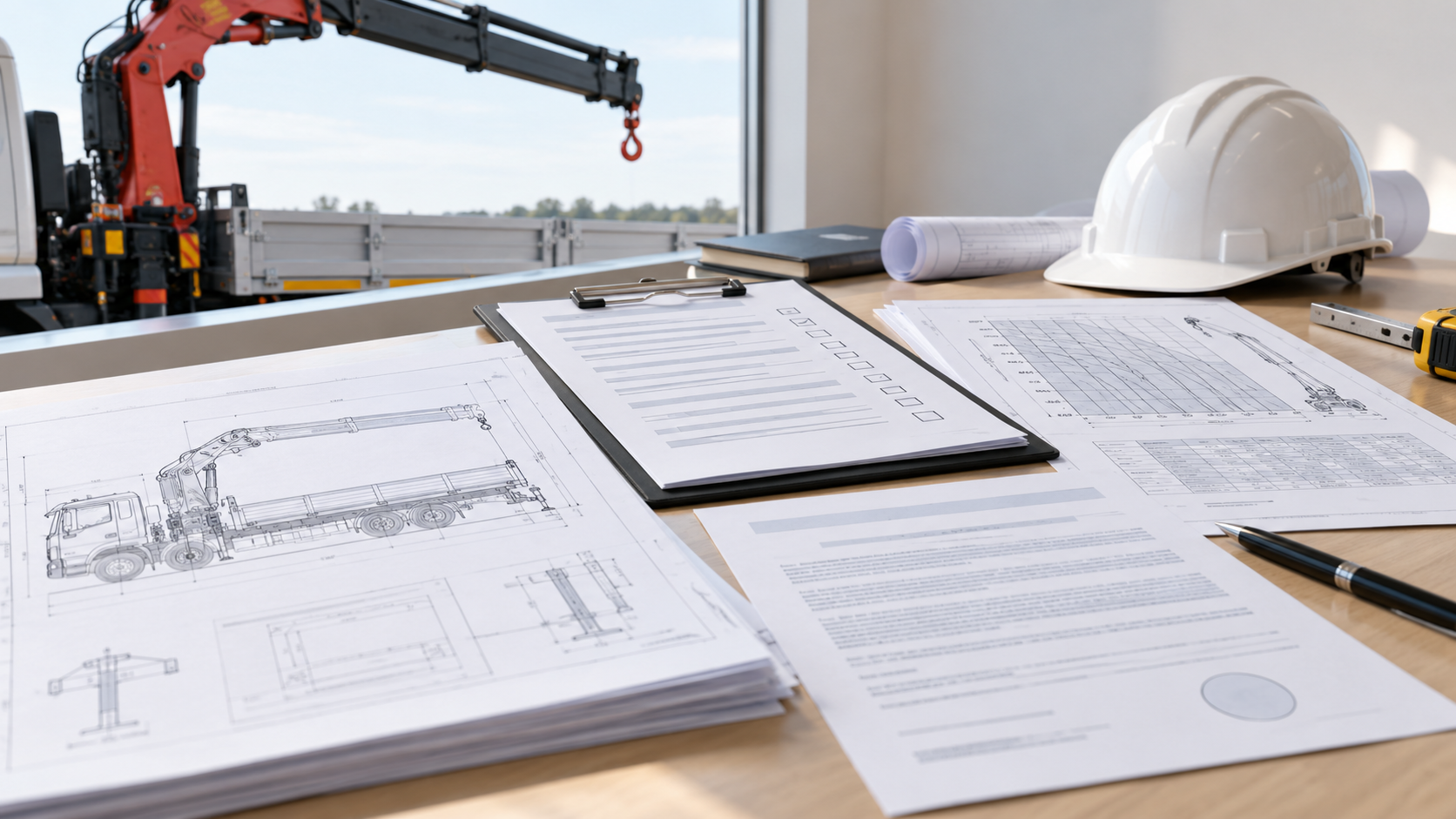
A practical truck mounted crane compliance package may include the following, depending on the product and destination:
- Crane model, serial number, and identification-plate information.
- Technical specifications and rated lifting capacity.
- Load chart showing capacity at different working radii.
- Installation dimensions and crane-to-chassis interface information.
- Operating and maintenance manuals.
- Hydraulic and electrical diagrams where required for installation or maintenance.
- Factory inspection and load-test records, with applicable test conditions.
- Conformity declarations or certificates required for the destination market.
- Supplier warranty and spare-parts information.
- Commercial invoice, packing list, transport document, and origin documentation when needed.
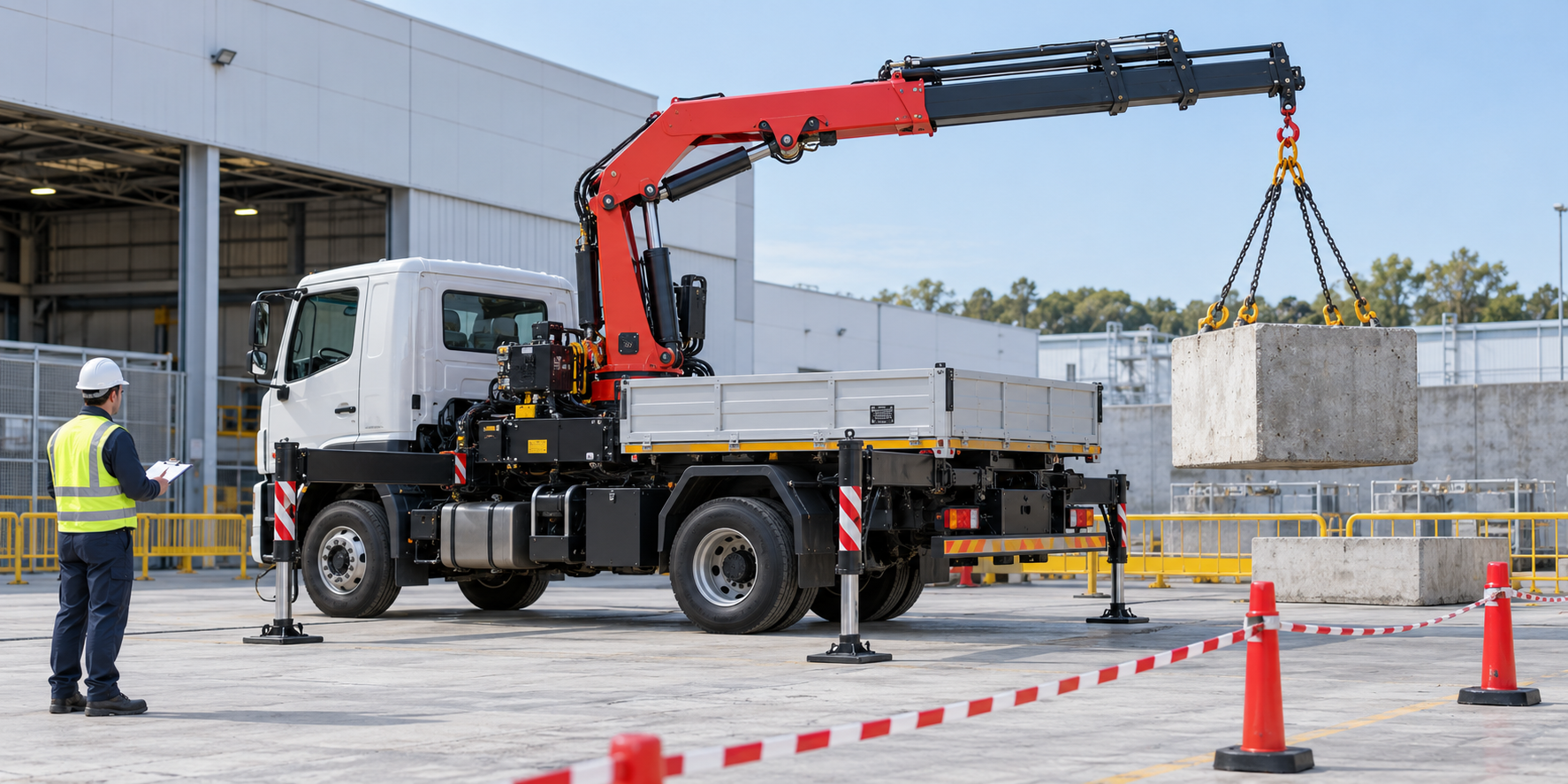
Important: A factory load test is valuable but does not automatically replace a legally required third-party inspection, conformity assessment, or examination after installation. Buyers can also compare the supplier’s test records with the checks described in what buyers should check in a truck mounted crane load test.
11. Crane-Only Shipment vs Complete Crane Truck
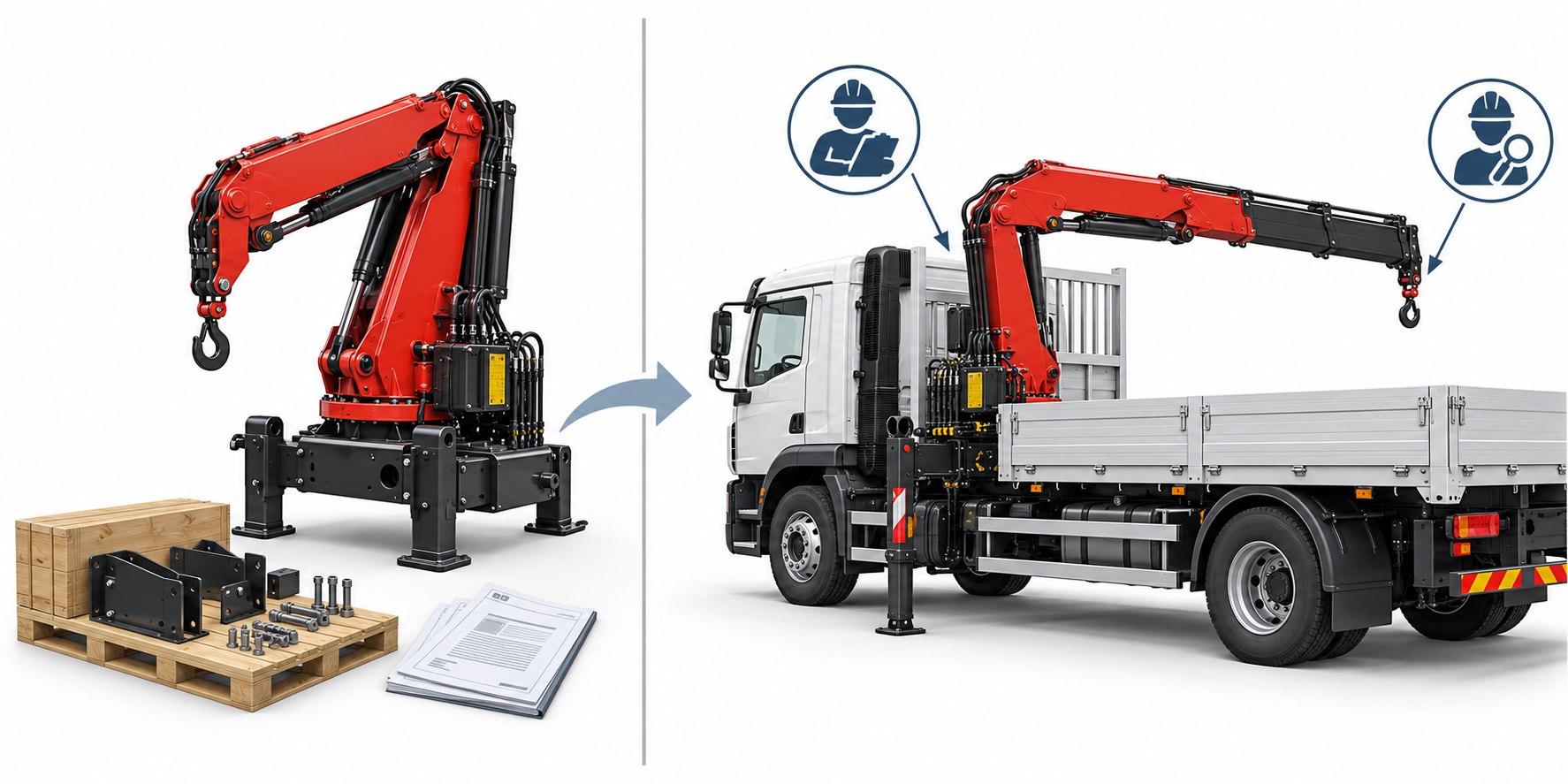
This distinction is often overlooked. If a buyer imports a crane without the truck, the local installer may become responsible for the mounting design, power connection, weight distribution, chassis reinforcement, and final checks. The crane manufacturer’s documents do not by themselves prove that the completed vehicle is safe.
If the equipment arrives as a complete crane truck, road-registration, axle-load, dimensions, emissions, lighting, and other vehicle requirements may apply in addition to lifting-machinery requirements. Buyers should confirm early whether they are importing a standalone crane or a completed vehicle. The difference is also relevant when planning how a truck mounted crane is shipped overseas.
12. How HAOY Supports International Buyers
Xuzhou Haoyi Engineering Machinery Technology Co., Ltd. (HAOY) supplies truck mounted cranes and other customized lifting equipment, including marine cranes and vehicle-mounted aerial work vehicles. HAOY supports OEM/ODM customization with a minimum order quantity starting from one unit, which can be useful when a buyer needs a crane matched to a particular chassis, application, or destination market.
For cross-border projects, buyers can discuss the required crane type, working radius, control system, installation layout, and documentation before confirming the order. However, the required certificates, approval pathway, and whether a particular model already has the necessary evidence should always be confirmed in writing for that destination. Customization and one-unit MOQ do not by themselves establish regulatory compliance.
13. A Practical Pre-Order Compliance Checklist
Before paying a deposit or approving production, use this short checklist:
- Identify the destination country and, where relevant, the state or province.
- Confirm whether you are buying a standalone crane or a complete crane truck.
- Define the crane type, rated capacity, working radius, and intended use.
- Ask a local importer or specialist which product and workplace rules apply.
- Request model-specific conformity documents and load charts from the supplier.
- Verify who will install and inspect the crane after arrival.
- Confirm the language and format of required labels and manuals.
- Record any special requirements in the purchase agreement before production.
This process reduces the risk of finding out after shipping that the crane requires additional modifications, documents, or inspection.
Frequently Asked Questions
Is CE marking required for truck mounted cranes imported into the EU?
It is commonly required where the equipment falls under applicable EU machinery legislation. Buyers must verify the precise scope, conformity process, and responsibilities for the crane and any completed installation.
Does a truck mounted crane need CE marking in the United States?
CE marking is not generally a US import requirement. US workplace, technical, and road-vehicle requirements should be evaluated according to the crane and its intended use.
Is ISO 9001 enough to import a crane?
No. ISO 9001 concerns quality management. It does not replace a load chart, product-specific conformity documents, customs documents, or local inspections.
Can the same crane be sold in different countries?
Potentially, but equipment configuration, labeling, documentation, inspections, and approval requirements may need to change between markets. Market suitability should be confirmed before shipment.
Does a factory load test replace local crane inspection?
Not necessarily. Local rules may require a competent-person examination, inspection after installation, or periodic checks even when factory testing was completed.
What should I tell the supplier before requesting a quotation?
Provide the destination country, intended application, crane capacity, working radius, truck chassis details, and any known compliance or inspection requirements. This helps the supplier determine whether the requested configuration and documentation are feasible.
Conclusion
Truck mounted crane certification requirements depend on where the equipment is sold, how it is configured, and how it will be used. EU CE-related requirements, UK equipment rules, US OSHA and ASME considerations, Canadian provincial rules, and Australian standards are not interchangeable. Import paperwork, product conformity, completed-vehicle approval, and in-service inspections are separate questions.
For international buyers, the best approach is to verify local requirements before production, request documents tied to the actual crane model, and confirm who is responsible for installation and inspection. This is more reliable than choosing a supplier on the basis of a single certificate or logo.
If you are sourcing a customized truck mounted crane from China, send the supplier your destination market, chassis information, lifting requirements, and project application. You can then discuss the available configuration and documentation before committing to the order.