
Truck Mounted Crane vs Boom Truck: The Short Answer
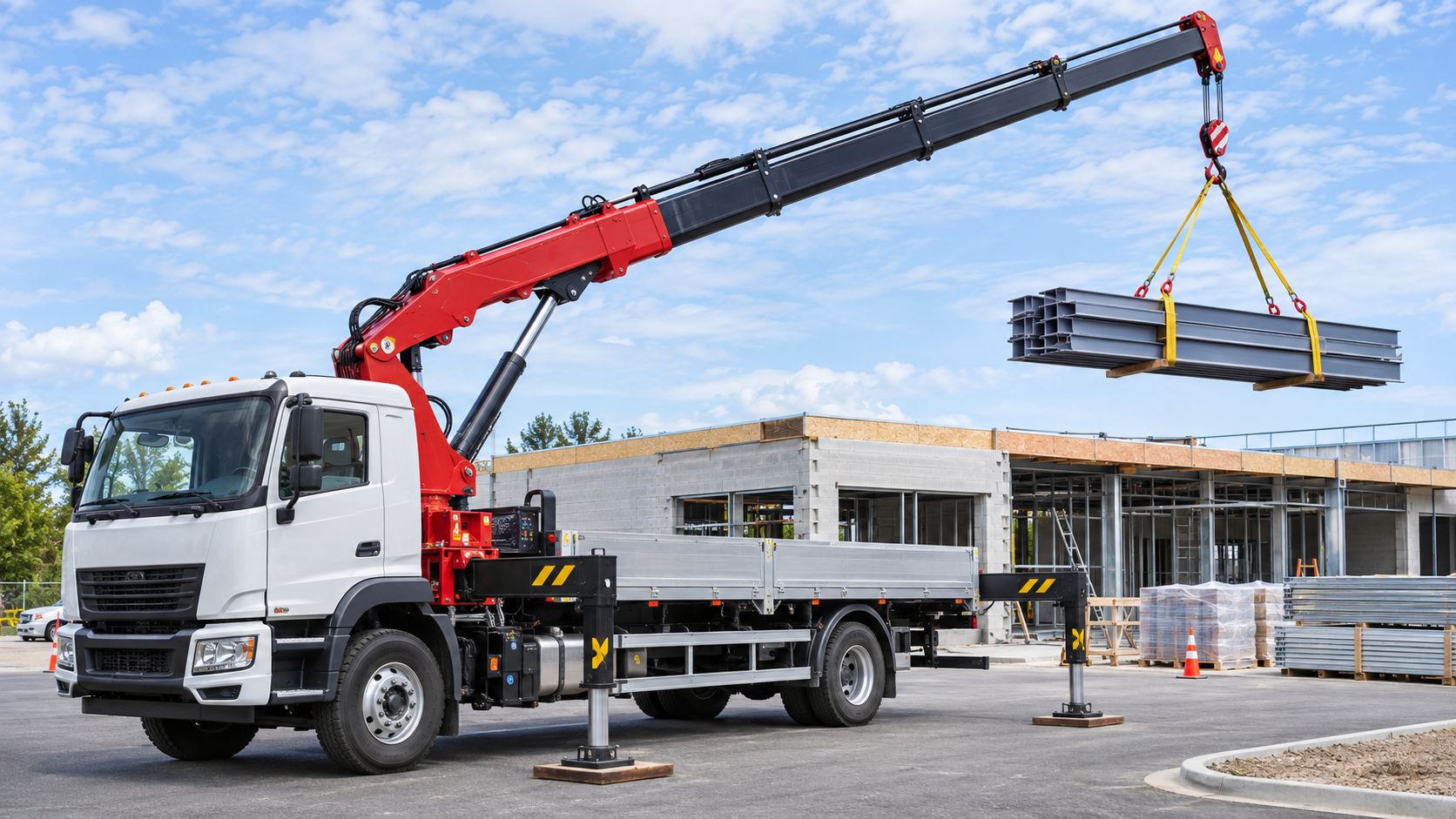
A boom truck is usually a type of truck-mounted crane, rather than a completely separate kind of machine. In North America, “boom truck” commonly describes a commercial truck fitted with a lifting boom, often a straight telescopic boom. “Truck mounted crane” is a broader term used internationally for cranes installed on truck chassis, including straight telescopic and articulated knuckle boom designs. The exact meaning depends on the seller, region and crane configuration.
For buyers, the name alone does not tell you how much the machine can lift or whether it will suit a particular job. The details that matter are the load chart, working radius, boom geometry, truck chassis, installation layout and permitted operating conditions. Those should be compared before prices.
| Term | Typical meaning | What to verify |
|---|---|---|
| Truck mounted crane | Broad term for a crane installed on a truck chassis | Boom style, mounted crane only or complete truck |
| Boom truck | Common North American term, often a telescopic boom crane truck | Load chart, truck body, operating category |
| Knuckle boom / articulating crane | Folding, jointed boom; often used for loading tasks | Articulation, stowed dimensions, attachments |
| Crane truck / lorry loader | Regional names that may overlap with the above | Specific machine and intended job |
1. Why Do Buyers Use Different Names?
Crane terminology grew out of local markets. A contractor in the United States may ask for a boom truck to lift roofing supplies onto a building. A buyer in Europe may describe a similar vehicle as a truck-mounted crane or lorry loader. A buyer purchasing a hydraulic knuckle boom from China may search for a truck mounted crane even when ordering the lifting unit without a truck.
These names can overlap. Some boom trucks use telescopic booms, but not every truck-mounted crane is telescopic. Likewise, “boom truck” is sometimes used loosely in online listings. It is better to ask for photographs, dimensional drawings and the exact load chart than to infer a design from one product name.
2. Boom Design: Straight Telescopic or Articulating?
Straight telescopic boom
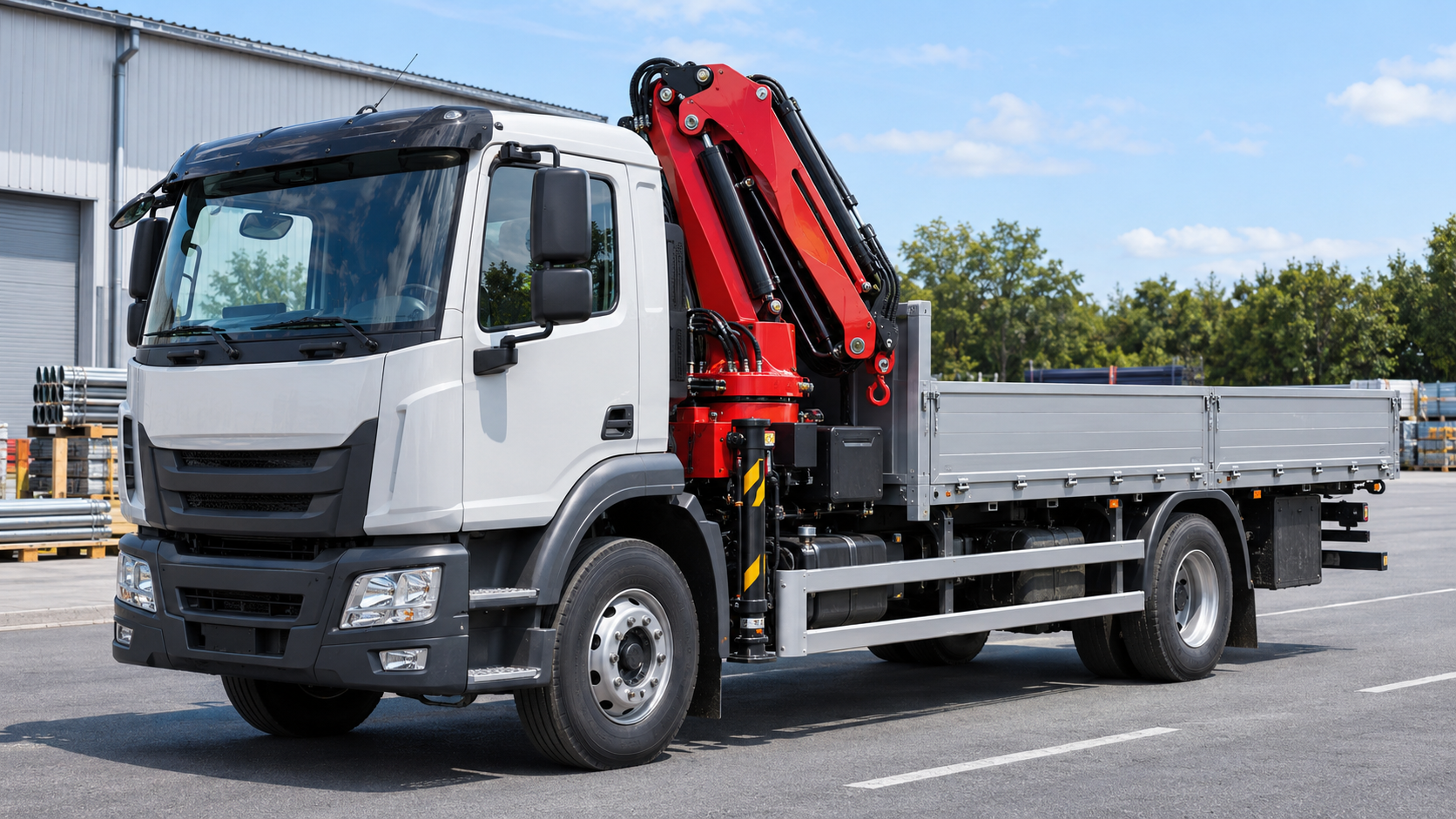
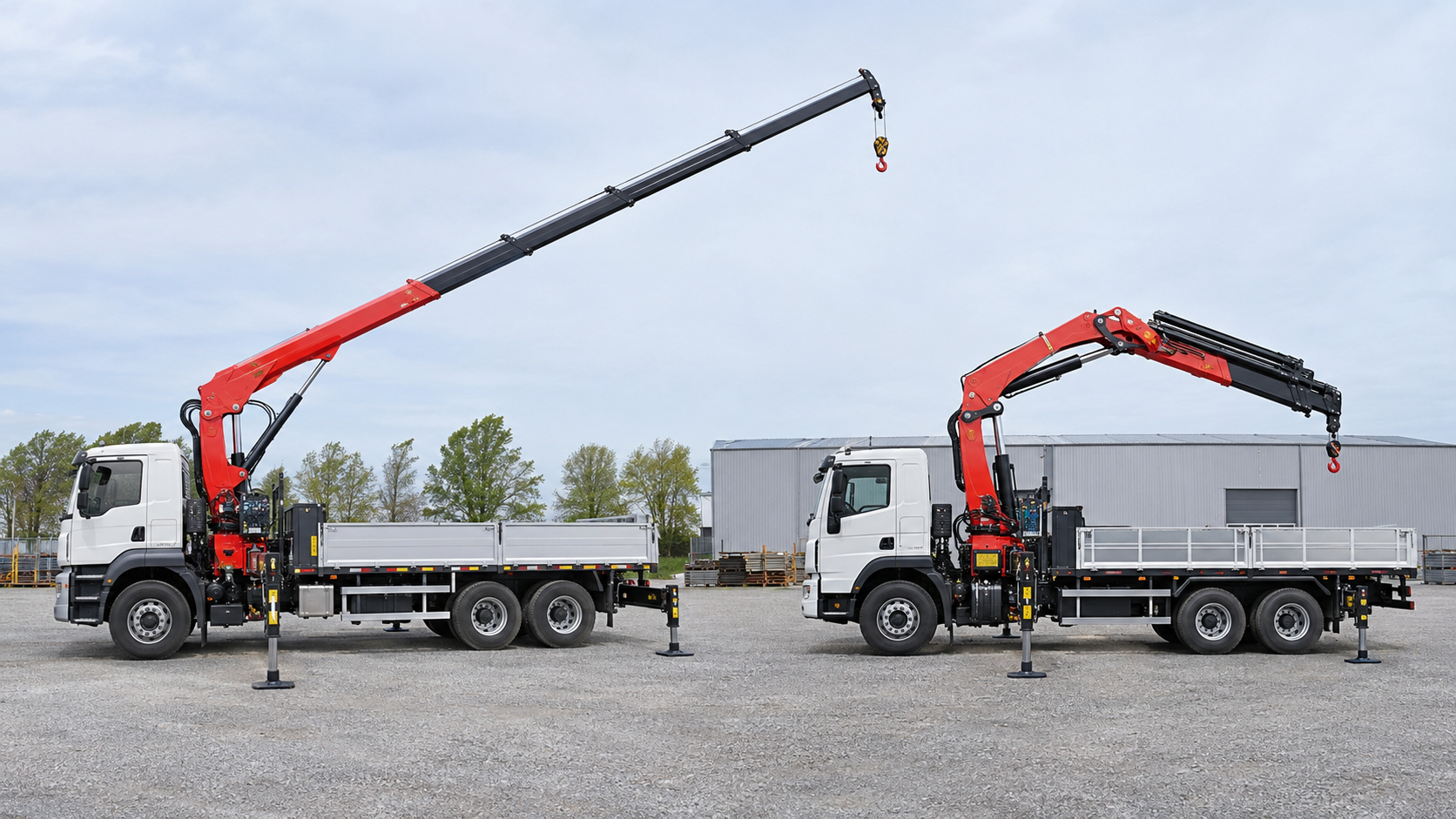
A straight telescopic boom extends sections along a largely straight line. Buyers may prefer this arrangement for lifting materials to height or reaching across an open work area. The design is common in many machines marketed as boom trucks in North America. A winch may be used, depending on the model.
Articulating knuckle boom
A knuckle boom uses hinged sections that fold against one another. Its compact stowed shape can help preserve space and make loading tasks easier where there are obstacles. It is frequently chosen for delivery trucks, utility service vehicles, recycling and equipment handling. Some models use a hook at the boom tip, while others carry a grab, auger or other attachment.
Neither geometry is automatically safer or more powerful. A straight boom may suit a simple long-reach lift; an articulating boom may handle positioning around an obstruction more conveniently. Actual capability depends on the rated configuration and approved load chart.
3. Lifting Capacity and Reach Are More Important Than the Name
An “8-ton truck mounted crane” and an “8-ton boom truck” are not necessarily comparable. Maximum rated capacity is normally stated for a particular geometry and operating condition. As the working radius increases, allowable capacity typically falls. The truck’s available payload and axle limits can also affect how the complete vehicle is used.
For example, a buyer who needs to place a 1.5-ton object 9 meters away should ask for the rated capacity at that specific radius and crane setup. The figure in the product title is not enough. Also check whether hooks, slings, grabs, spreaders and other lifting accessories count toward the load handled by the crane.
Do not use a simple lifting-moment calculation as a substitute for the manufacturer’s chart. Boom self-weight, stability, geometry, support condition and safety requirements all influence the approved capacity.
4. Truck Body, Cargo Space and Payload
A boom truck sold as a complete vehicle may include a flatbed, service body or other work body. A truck mounted crane can also be sold as a crane-only unit for installation by a qualified local body builder. These two purchasing formats change the logistics, installation scope and final cost.
A crane installed behind the cab occupies space near the front of the body. A rear-mounted crane occupies space at the back and changes how loads and chassis forces are distributed. Neither location is universally better: the wheelbase, axle ratings, cargo distribution, subframe and outrigger layout must be checked together.
A buyer should request both the crane mass and the expected finished-vehicle mass. A powerful crane is of little practical use if the modified truck cannot carry its normal cargo or comply with local weight limits.
5. Hydraulic Power, Controls and Attachments
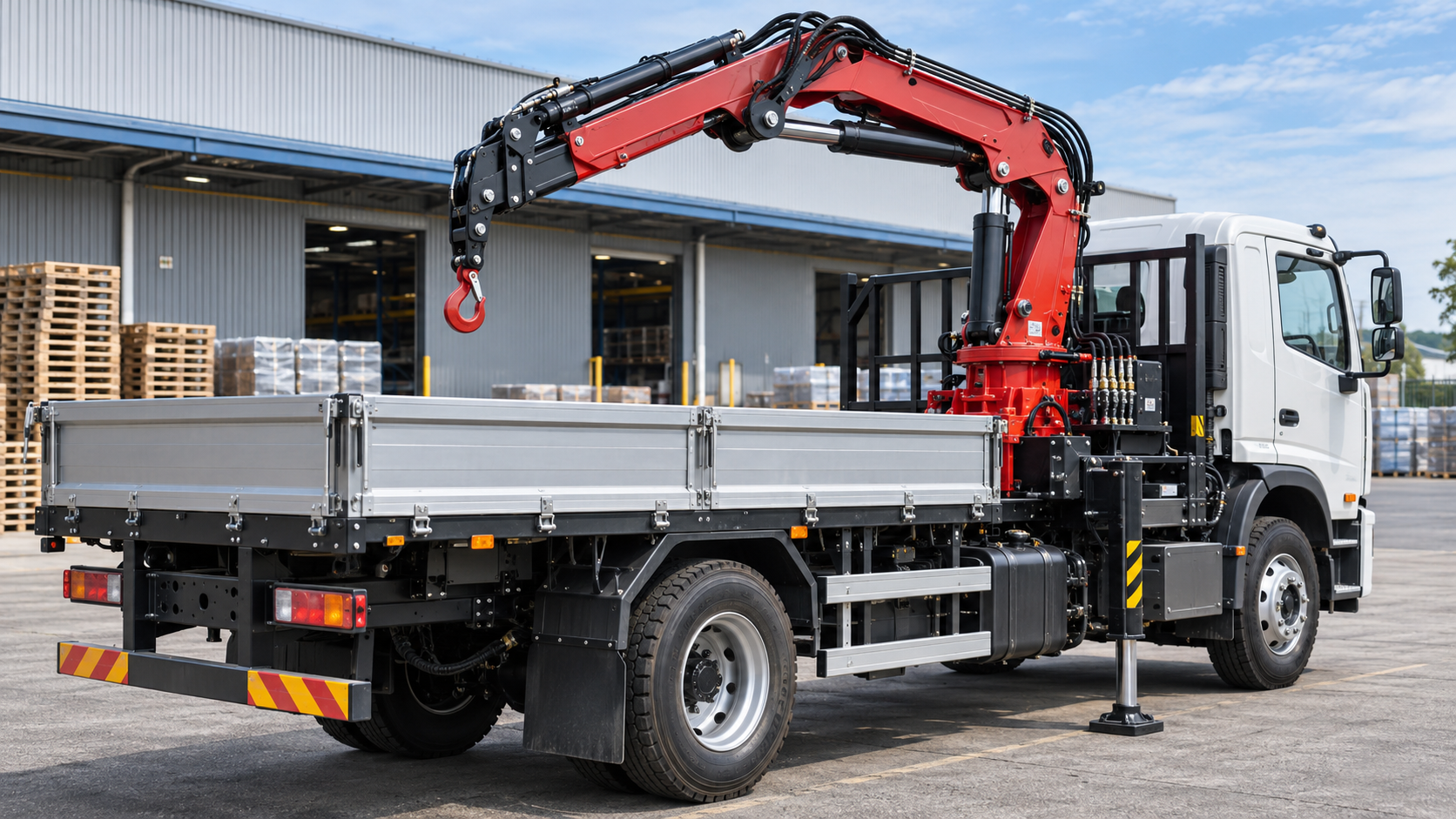
Most hydraulic truck cranes need a suitable power supply, commonly through a truck power take-off (PTO) and hydraulic pump. Some small or specialized designs use separate power packs. Before ordering, confirm PTO compatibility, oil flow, system pressure, oil-cooling requirements and available mounting space.
Control options can include manual valve controls, proportional controls and wireless remote control. Remote control may improve the operator’s view of the load, but it does not remove the need for exclusion zones, safe lifting plans or properly functioning emergency stops.
Attachment choice also matters. The same crane platform might be used with a hook, winch or grab when approved for that configuration. Confirm that the load chart, hydraulic functions and lifting instructions cover the proposed attachment.
6. Outriggers, Stability and Safety Requirements
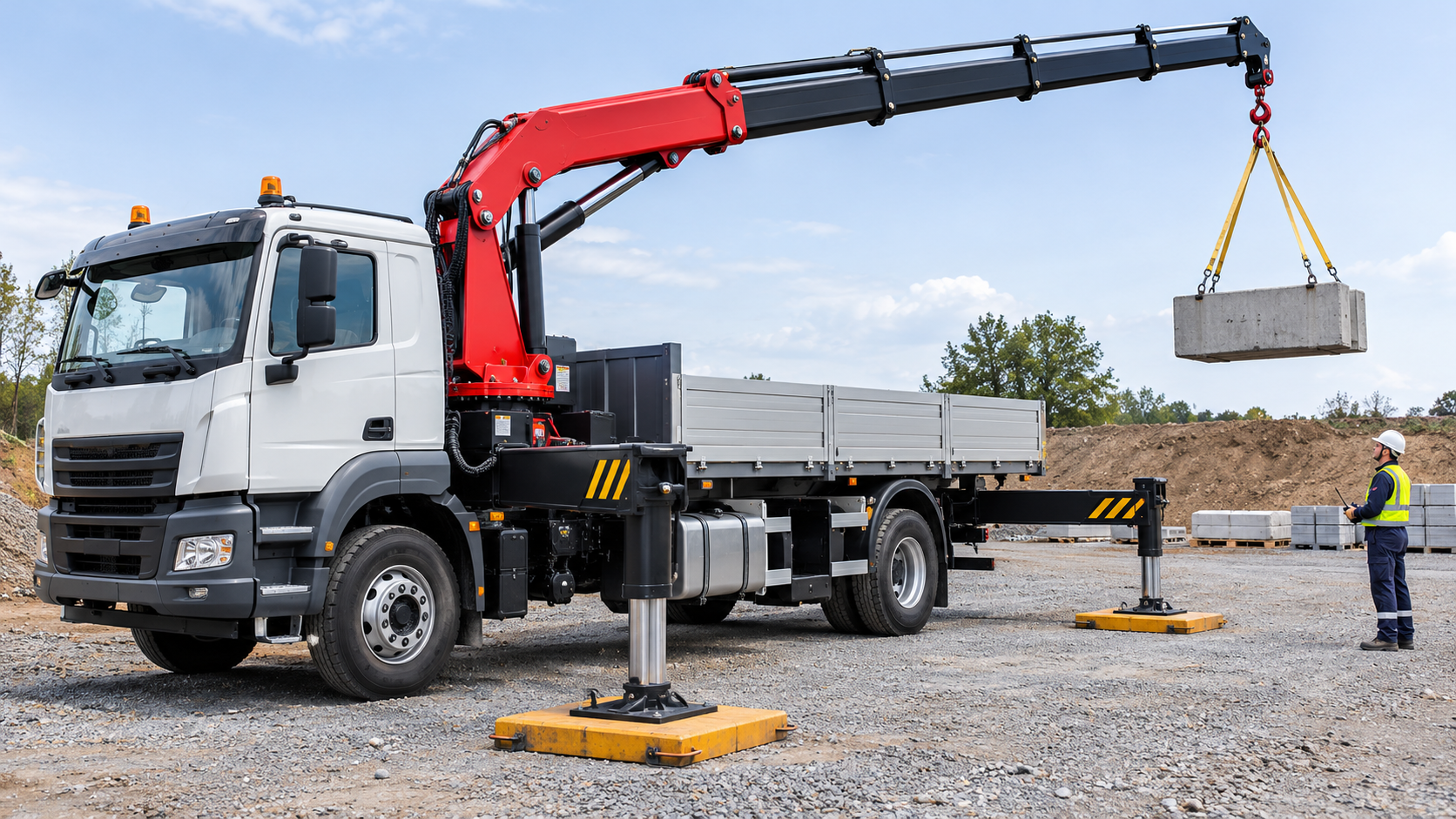
Whether a listing says boom truck or truck mounted crane, the buyer should verify the support arrangement. Outriggers transfer lifting forces into the ground through the truck and crane structure. Their approved extension, ground bearing pressure and pad setup can be critical. Soft soil, slopes and restricted roadside working areas require special attention.
Ask whether the machine includes the safety functions appropriate to its design and destination market: load-moment monitoring where applicable, holding valves, movement limits, emergency stops, warnings and operating instructions. Do not assume every crane offered under either name has identical protection.
Regulatory categories and inspection obligations differ by country and application. For example, a telescopic boom truck and an articulating loader crane may be addressed differently under local rules. Confirm the applicable standards, operator qualifications and inspection requirements with a qualified professional in the destination market.
7. Which One Is Better for Your Application?
The answer depends on the lift, not the wording in a catalogue. These examples are starting points, not model approvals:
| Application | A useful starting point | Main buying question |
|---|---|---|
| Roofing and building supplies | Straight telescopic boom truck | What can it lift at roof height and radius? |
| Urban delivery / tight unloading | Articulating truck mounted crane | Can the boom position the load around obstacles? |
| Utility and municipal lifting | Either, depending on task | What are the load, clearance and site constraints? |
| Equipment loading at multiple stops | Knuckle boom or straight boom | How much bed space and payload remain? |
| Occasional use on an existing truck | Crane-only truck mounted unit | Can the chassis and PTO be approved for installation? |
For work near power lines, choose equipment and work methods based on the electrical hazards and local safety rules, not simply on whether a crane has a remote control. Lifting suspended loads and lifting people are also different tasks. A crane must not be used to lift personnel unless it is specifically designed and approved for that use.
8. How to Compare Quotes from Chinese Suppliers
A quotation for a bare hydraulic crane and a quotation for a finished boom truck may appear to differ greatly even when the lifting equipment is similar. Buyers should compare the exact supply scope before drawing conclusions. See How to Choose a Reliable Truck Crane Supplier in China for supplier-evaluation guidance.
- Crane-only unit or complete vehicle, including truck brand and chassis specification
- Model, boom type, rated capacity at the required radius and full load chart
- Crane weight, stowed dimensions, subframe and required mounting position
- Outriggers, PTO and hydraulic power package included or excluded
- Control system, emergency stop, accessories and optional equipment
- Technical drawings, inspection records, installation guidance and spare-parts support
- Applicable local compliance responsibilities, packaging and shipping terms
It is reasonable to request a short application review before comparing prices. When the supplier understands the task, truck and lifting radius, the quoted configuration is less likely to need costly revisions after arrival.
9. How HAOY Supports Different Truck Crane Requirements
HAOY, the brand of Xuzhou Haoyi Engineering Machinery Technology Co., Ltd., offers truck mounted crane solutions including knuckle boom and telescopic boom configurations. The company supports OEM/ODM customization for applications that require different boom arrangements, control methods, installation positions and accessories. Complete customized equipment orders can start from one unit, subject to technical feasibility and the agreed specification.
For buyers comparing a truck mounted crane with a boom truck, the practical first step is to send the truck chassis information, maximum load, required radius and typical lifting scenario. That gives the engineering team a clearer basis for proposing a configuration, rather than selecting a model solely from the name used in the enquiry.
10. Buyer Checklist Before Requesting a Quote
- Is the order for a lifting unit only or a complete crane truck?
- What is the heaviest load, including lifting gear?
- What are the required working radius and lifting height?
- Will the boom operate around buildings, trees or overhead obstacles?
- What chassis model, wheelbase and axle ratings are available?
- Where will the crane be mounted, and how much cargo body space is needed?
- What outrigger setup, controls and accessories are required?
- Which destination-country approvals and installation checks apply?
FAQ: Truck Mounted Crane vs Boom Truck
Is a boom truck the same as a truck mounted crane?
Often, yes in everyday usage. A boom truck usually refers to a truck equipped with a lifting boom, while truck mounted crane is a broader term. Always verify the exact machine configuration.
Does a boom truck always have a telescopic boom?
No. The name often suggests a straight telescopic boom in North America, but sellers may use it more broadly. Photos, drawings and load charts are more reliable than the label.
Is a knuckle boom crane better than a boom truck?
Not in every application. Knuckle booms can be convenient for compact stowage and positioning around obstacles. Straight telescopic booms may suit open-area lifts requiring direct height or outreach. Compare actual load charts and access constraints.
Can I buy the crane without a truck chassis?
Yes, some suppliers offer crane-only units. Installation still requires engineering checks for frame strength, mass distribution, PTO, subframe and compliance with local vehicle rules.
Which crane is more expensive?
There is no reliable universal answer. Capacity at radius, boom length, chassis inclusion, bodywork, outriggers, controls, installation and transport all affect the price. Compare like-for-like supply scopes.
What should I tell a supplier if I am unsure which name to use?
Describe the task instead: load weight, distance, height, truck model, installation location and jobsite conditions. Those details are enough to start a useful technical discussion.
Conclusion
The distinction between a truck mounted crane and a boom truck is mainly a matter of terminology and configuration, not a simple choice between two separate machine classes. In many markets a boom truck is one form of truck-mounted crane; in North American listings it often describes a complete truck fitted with a straight telescopic lifting boom. Truck mounted crane also covers articulating knuckle boom products and crane-only installations.
For a sound purchase decision, compare the lifting load at the required radius, boom movement, chassis and payload limits, outriggers, control system and service support. A clearly defined working requirement will lead to a better recommendation—and a more useful quotation—than the product name alone.
For quote preparation, also review What Information Is Needed Before Requesting a Truck Mounted Crane Quote? and provide the actual load, radius, chassis and operating conditions.